

Let me ask you something.
How many events do you think happen on a corporate network every minute?
Logins. Failed logins. File accesses. Network connections. System changes. Application errors. Policy violations.
Take a guess.
I bet you think it is less that it really is.
On a medium-sized corporate network, we are talking about tens of thousands of log entries every single minute. Hundreds of thousands per hour. Millions per day.
Now imagine your job is to find the three events in that ocean of data that actually indicate a real attack.
That is what a Security Information and Event Management system - a SIEM - is designed to help you do.
So what can you expect today?
Quick question before we start: Have you ever worked with a SIEM, or is this your first time learning about one? Let me know in the comments. I read every reply.
After reading this article, you will understand:
What a log actually is and why it is the foundation of everything in security operations
What a SIEM actually does in a real environment
Why collecting every log is the worst mistake you can make
Why false positives are the real operational challenge
What CC, Security+, and CISSP candidates need to know for the exam
Warning: CC, Security+, and CISSP relevant topic.
It All Starts with Logs
Before we deep dive into complicated theory, let’s make just one thing clear.
Because without knowing what a log is, everything else that follows simply won’t make sense.
Every operating system, application, firewall, cloud service, and network device constantly records events. These records are called logs.

Some examples include:
A user successfully logs in.
A firewall blocks a suspicious connection.
A web server receives a request.
A new administrator account is created.
An employee connects through the VPN.
Think of logs as the digital footprints left behind by every activity inside your environment.
As each device in your infrastructure generates some logs, it would be very difficult to work with them. That’s why they are typically stored in one place, where we can manage the logs in accordance with the company’s policies.
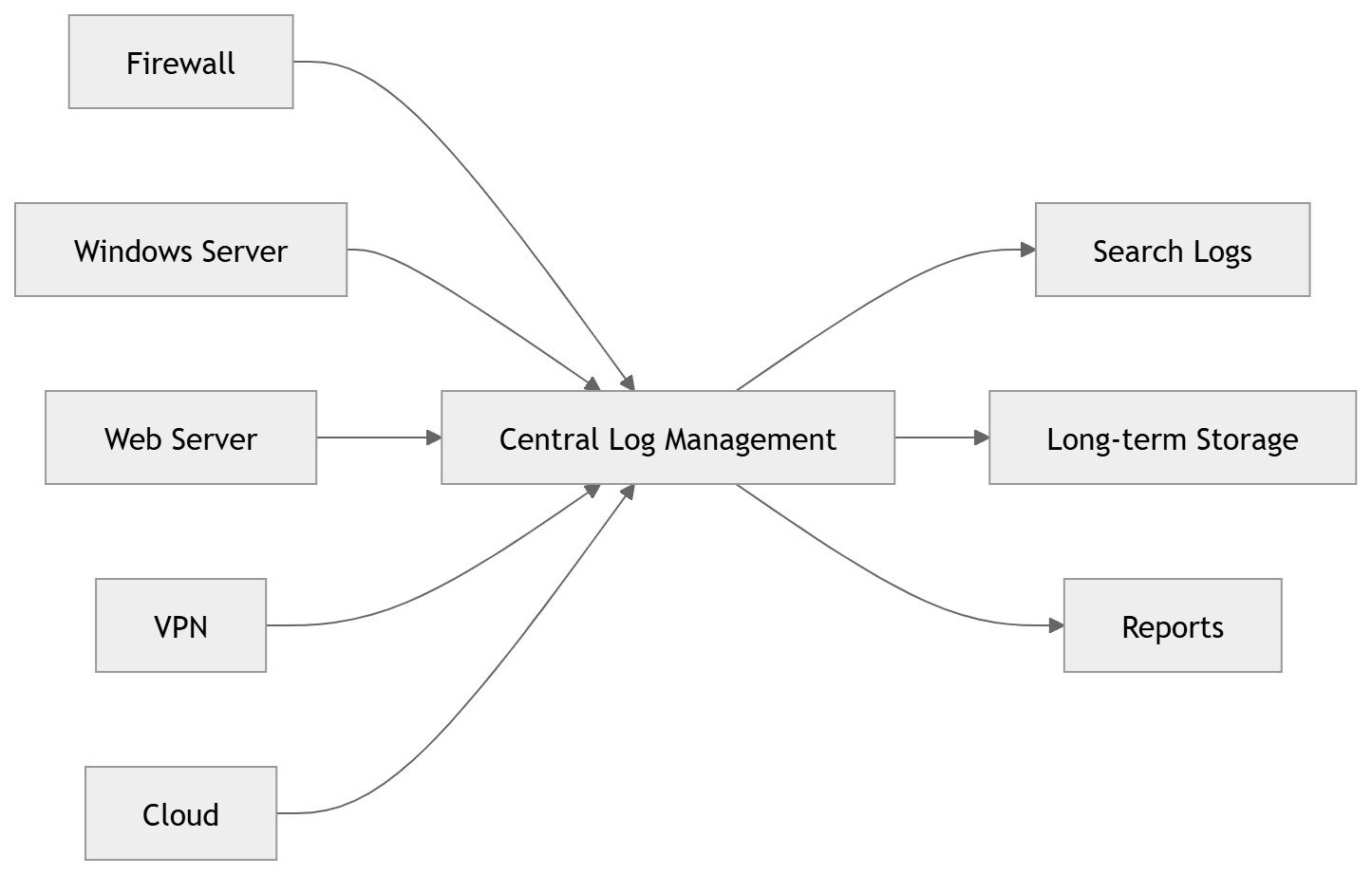
Collecting all of this information is useful, but only if you can actually find what you’re looking for. Otherwise, you have just hard drives full of data.
Did anything surprise you so far? Most people don't realize how many logs a typical company generates every day.
What a SIEM Actually Does
A common misconception is that a SIEM is simply a place where logs are stored.
It isn’t. That’s log management.
A SIEM is a system that continuously analyzes logs coming from different sources and looks for suspicious relationships between them.
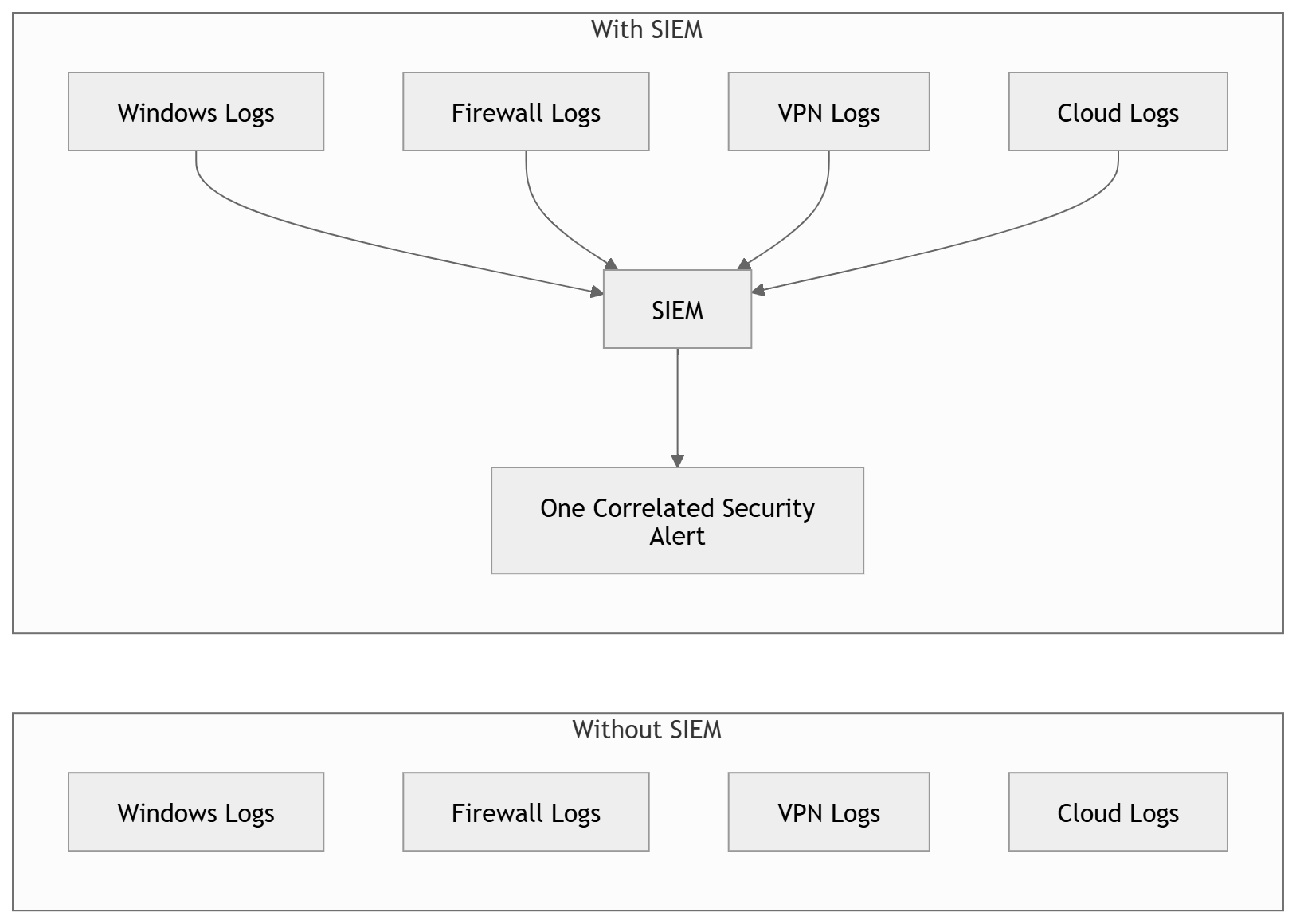
Imagine these three events happen within five minutes:
A user successfully connects through the VPN.
PowerShell starts on a production server.
A new administrator account is created.
Individually, none of these events necessarily indicates malicious activity.
Employees connect through VPNs every day.
System administrators use PowerShell constantly.
New administrator accounts are occasionally created.
But when all three happen together, using the same account within a very short time window, they tell a much more interesting story.
A SIEM identifies these relationships using correlation rules.
Instead of looking at individual log entries, it asks questions such as:
“Did Event B happen shortly after Event A?”
or
“Did the same user trigger these events across multiple systems?”
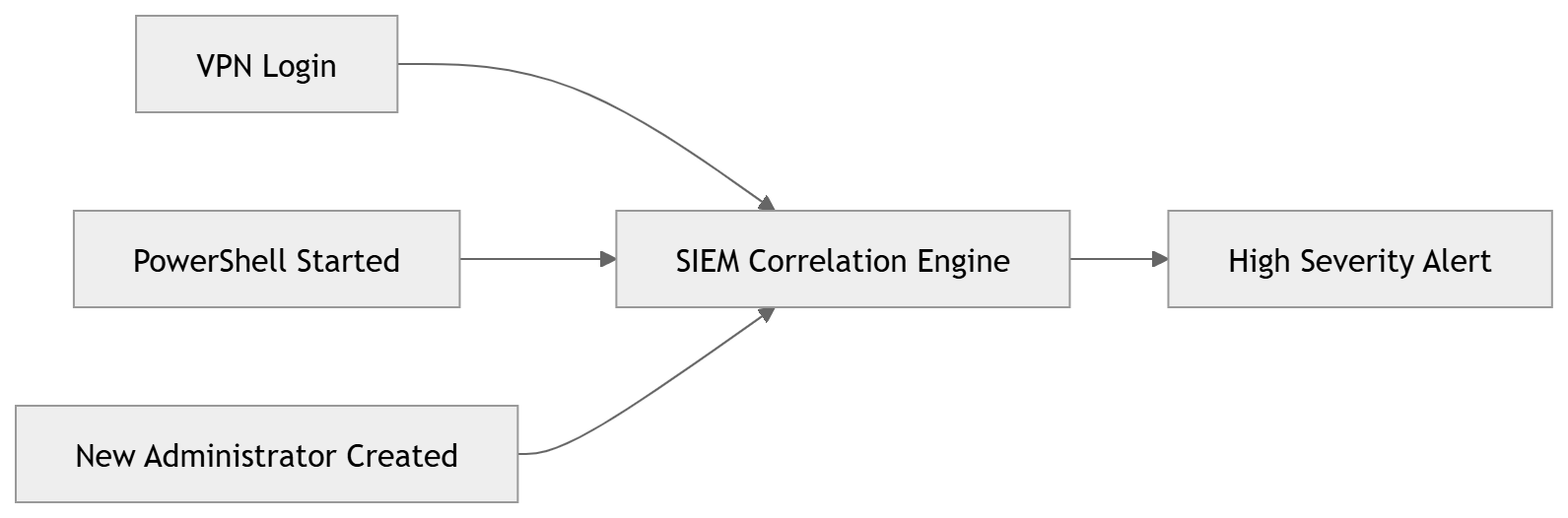
If the answer is yes, the SIEM generates an alert for a security analyst to investigate.
This is what makes a SIEM so powerful. It doesn’t just collect information. It connects the dots between them.
Well, there is one slight problem with that…
Discussion: In your experience, what’s the biggest mistake organizations make when implementing a SIEM?
Collecting too many logs?
Poor detection rules?
Never tuning the system?
Not having enough analysts?
Or is it something else?
The False Positive Problem
It all sounds nice. You have a system that correlates events and tells you when something bad is going on.
It might sound impressive until you realize that only like 1% of those alerts represent actual malicious activity.
Everything else is just people working, and your SIEM flagging them. This is known as a false positive.
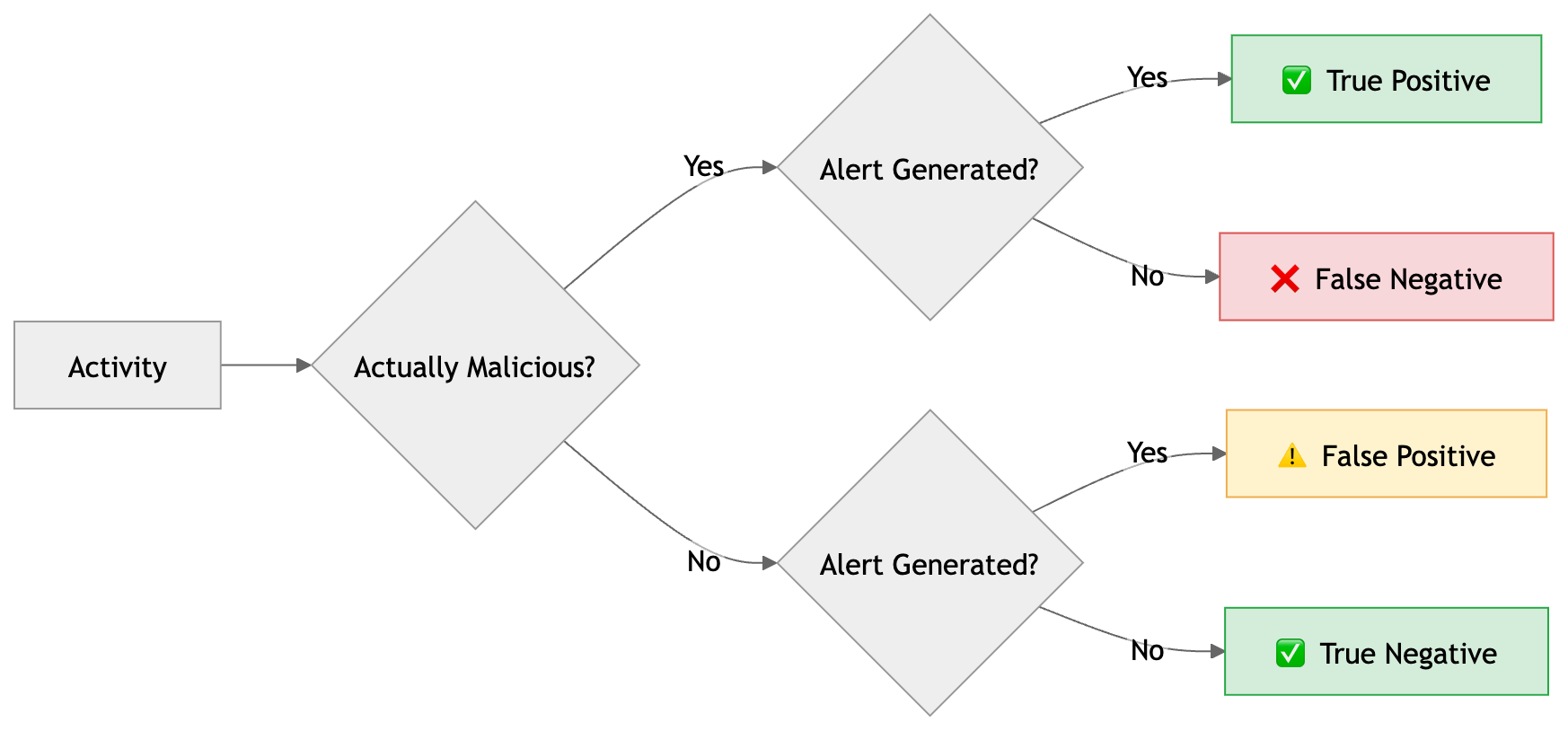
A false positive is an alert that appears suspicious but ultimately turns out to be legitimate activity.
And this is where it gets actually difficult. Tuning your SIEM and configuring it to reduce the number of false positives to a minimum while still being able to recognize malicious activity.
As you can see in the picture below, if you make the system too sensitive, it will flood you with false positives. If you make it too ignorant, you will miss real attacks.
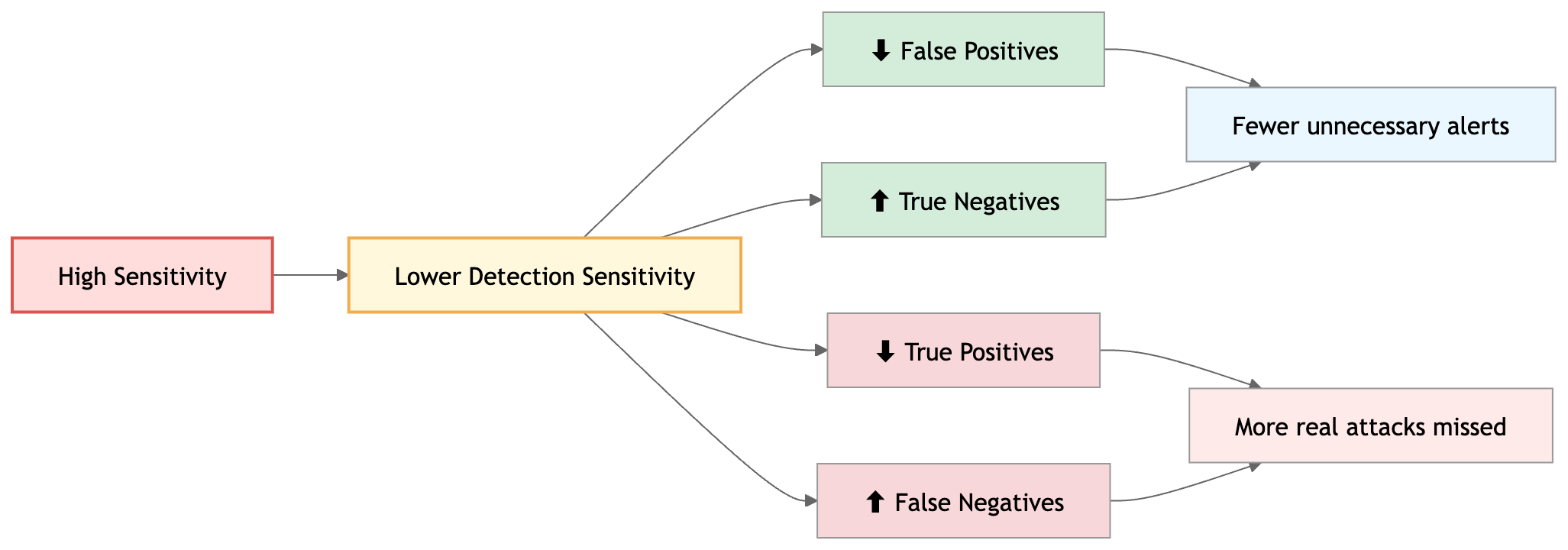
The funny thing is that there is no “general” template, and it requires a strong understanding of the environment.
It is very easy to just “set up” SIEM and then never look at it. Or flood your Incident Response team with countless alerts.
Neither of those options will actually improve your organization's security posture.
A good SIEM isn't measured by how many alerts it generates. It's measured by how many meaningful alerts it generates.
Exam Takeaways (CC, Security+, CISSP)
If you’re preparing for a certification exam, or you are about to implement SIEM remember this:
Log management is not the same as SIEM. Log management focuses on collecting, storing, and searching logs. A SIEM goes further by correlating events from multiple sources to detect suspicious activity.
More logs do not automatically mean better security. Collect the logs that provide security value. Ingesting every possible log increases costs, creates noise, and makes investigations more difficult.
SIEM requires continuous tuning. Detection rules must be refined over time to reduce false positives while maintaining the ability to detect real threats.
A SIEM is not a “set it and forget it” solution. Detection rules need regular updates as your infrastructure, applications, and attack techniques evolve.
A SIEM does not replace security analysts. It generates alerts, but people still need to investigate them, determine whether they are legitimate, and respond appropriately.
False positives are inevitable. The objective isn’t to eliminate every false positive. It’s to reduce them to a manageable level without significantly increasing the risk of missing real attacks.
Correlation is the primary value of a SIEM. Individual log entries rarely tell the full story. A SIEM connects related events across multiple systems to identify attacks that would otherwise remain hidden.
Remember: A good SIEM isn’t judged by the number of logs it collects or the number of alerts it generates. It’s judged by its ability to help analysts identify genuine threats quickly and efficiently.
Conclusion
At the beginning of this article, I asked you to imagine finding three malicious events hidden among millions of log entries.
Hopefully, you now understand why that task is impossible without the right tools, and why organizations rely on SIEM solutions to make sense of overwhelming amounts of security data.
But remember, a SIEM isn’t a magic box that will do it on its own.
It doesn’t automatically make an organization secure. It doesn’t stop attacks on its own. And it certainly doesn’t replace skilled security analysts.
A SIEM is only as effective as the logs it receives, the detection rules it uses, and the people responsible for tuning and monitoring it.
So remember that you NEED people to actually use the SIEM! Otherwise, it is just an expensive dashboard full of alerts.
One more question before you go: What's the biggest mistake you've seen organizations make when implementing a SIEM?
Want to go deeper on the concepts connected to SIEM?
SIEM sits at the heart of security operations. These articles build the complete picture:
Understand what happens when a SIEM fires an alert:
👉 The Incident Response Mistakes That End Interviews Early
See SIEM in action with a hands-on lab:
👉 Hands-On Lab: How Attackers Crack Passwords in 0.0006 Seconds
Understand the path that uses SIEM every day:
👉 How to Choose the Right Cybersecurity Role
Get a structured study plan for the SOC path:
👉 SOC Study Plan: Entry Level to Intermediate
Understand the networking that feeds logs into your SIEM:
👉 This Is How I Explain DNS To Beginners
👉 Top 5 Most Important Network Protocols
Build the Linux skills every SOC analyst needs:
👉 This Is How I Explain Linux To a Beginner
👉 Top 5 Linux Commands for an Entry-Level Cybersecurity Role
Let’s Connect
If you want to collaborate, discuss, or just geek out over networking and cybersecurity, reach out:
Email: erich.winkler@decodedsecurity.com
LinkedIn: Erich Winkler
Gumroad community: Decoded Security
Start Here: Decoded Security Roadmap
Enjoyed this article? Like it or drop a comment. I’d love to hear your thoughts and questions!
Let’s learn and grow together!
This is my first time learning about SIEM
Very detailed article! Especially I like the way how you connect these concepts to certifications!