

Do you want to break into cybersecurity, but feel confused by all the different roles?
If yes, this article is for you.
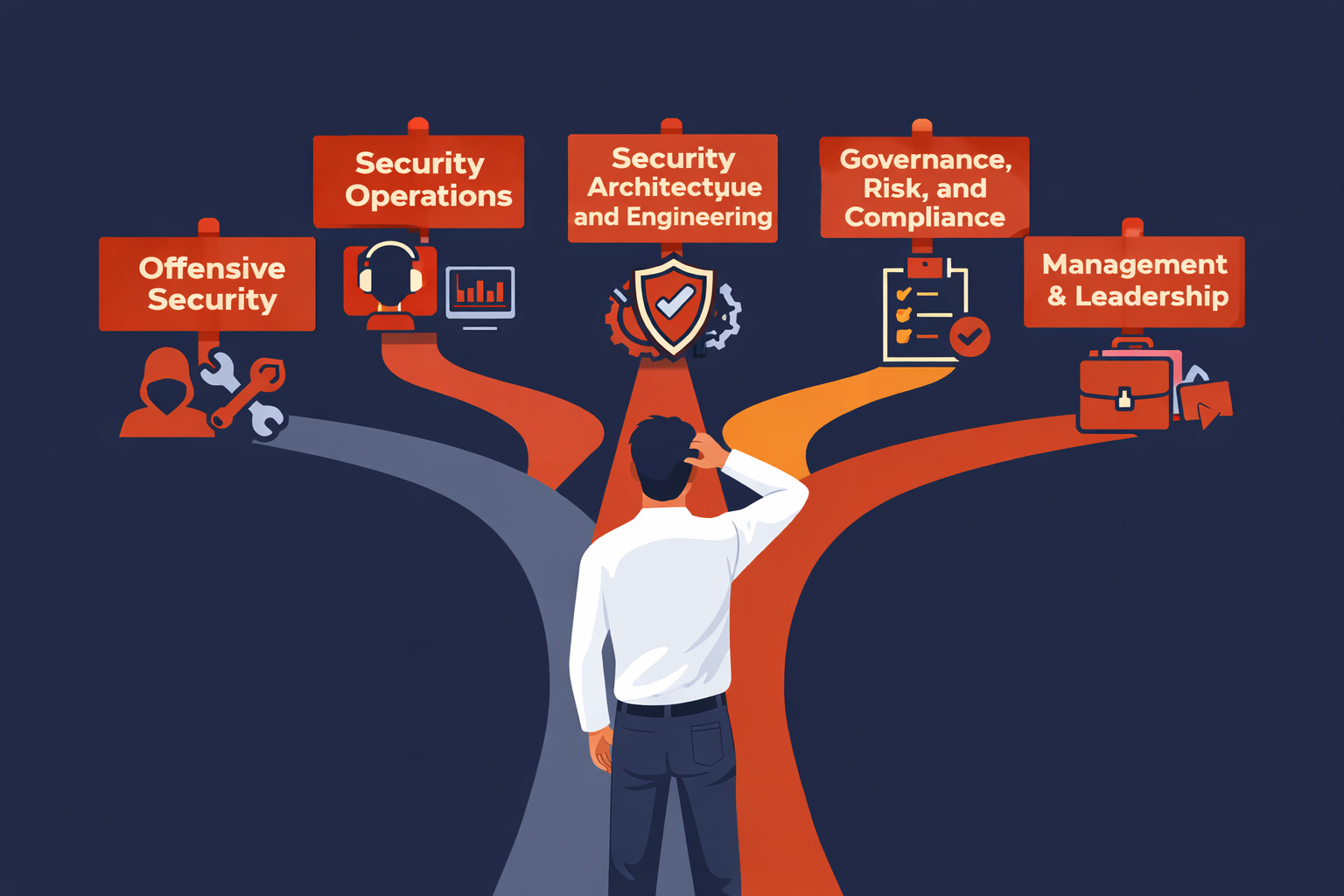
I’m going to give you a clear tour of the field and show you five very different paths you can take in cybersecurity—and how they actually relate to each other.
Why should you care?
Because choosing the wrong path can easily cost you years of effort and thousands of dollars in certifications, courses, and wasted preparation.
Cybersecurity is a demanding field.
And having direction puts you far ahead of people who are just “trying to figure it out.”
Most people don’t fail in cybersecurity because they aren’t smart enough.
They fail because they never had a plan.
Cybersecurity isn’t one job. It’s a system
Most people imagine security as a collection of isolated roles.
Pentester here.
SOC analyst there…
Cybersecurity manager somewhere at the top..
If we want to succeed, we have to change this mindset.
Cybersecurity is a living system with 5 main components.
Once you know these components, everything is much clearer.
Let’s go!
Not only people with cybersecurity roles have cybersecurity responsibilities. Cybersecurity is everyone’s responsibility. I covered this in one of my previous articles!

Interested in a personalized study plan based on your direction?
💬 Comment below with your details, and I'll send you free resources:
[Target role | Current level | Certifications you already have]
Not sure which path fits you? Take this free 60-second diagnostic and get a personalized reading list. No registration needed.
1. Offensive Security
Someone has to think like an attacker and ask:
How could this system be abused?
Where are the weak points?
What assumptions are we making that might be wrong?
These roles actively probe for weaknesses, but unlike malicious hackers, they do it to help organizations improve their security.
What roles are we talking about?
Penetration Tester
Required Seniority: Mid → Senior
I started with this role on purpose, because you probably heard about it the most. The first question I get when I say I work in cybersecurity is: “Can you hack my computer?”
PS: No, I can’t. I am not a penetration tester.
But what is the official goal of this role?
Penetration testers focus on controlled attacks against specific systems.
Basically, you tell him to break into a system under specific conditions and a time frame, and they do everything in their power to do so.
A good penetration tester doesn’t just find vulnerabilities.
They explain why they matter and how they can realistically be abused.
This role suits people who enjoy:
Structured testing
Technical depth
Clear objectives and reporting
But here’s the important part:
Penetration testing is not beginner-friendly.
Red Team Engineer
Required Seniority: Senior
Red Team Engineer takes it a little further.
Instead of testing individual systems, red teams simulate real-world attacks across the entire organization.
But, for the purposes of this article, red teaming is very similar to penetration testing.
Not all companies use Red teaming, as it is very expensive.
Additionally, it is highly unlikely to become a Red Team Engineer without prior experience as a penetration tester.
Do you find this article useful? Let me know in the comments!
2. Security Operations (SOC) Roles
If you don’t know what SOC is, it is the central team responsible for continuously monitoring, detecting, and responding to cybersecurity threats across an organization.
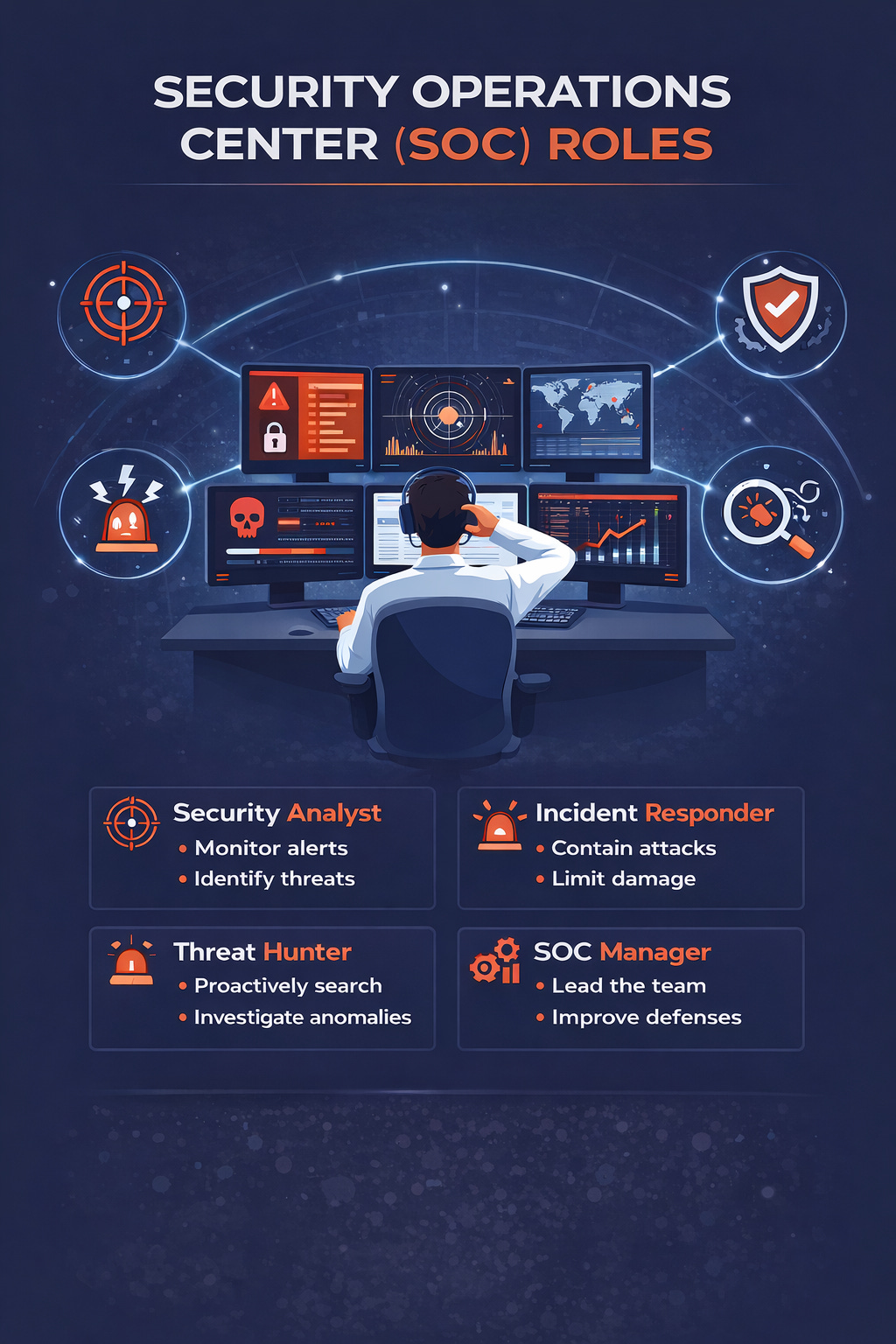
A SOC operates 24/7 (or close to it), because attackers don’t work office hours.
Security Analyst
Required Seniority: Junior → Mid
The security analyst is the front line.
This role is about:
reviewing security alerts
investigating suspicious behavior
deciding what is real and what is noise
Most alerts are false positives.
Some are not.
Your job is to tell the difference.
When something looks wrong, the analyst digs deeper to understand:
what happened
how serious it is
whether it needs immediate action
It is also one of the best entry points into cybersecurity, because it forces you to learn how attacks actually appear in real systems, not just in textbooks.
Incident Responder
Required Seniority: Mid → Senior
When an alert becomes a confirmed threat, the incident responder takes over.
This is the crisis role.
Incident responders focus on:
containing active attacks
limiting damage
removing attacker access
coordinating with other teams
They work under pressure, often with incomplete information, while systems are already compromised.
The key challenge here is balance:
move too slowly, and the attacker causes more damage
move too fast, and you might break critical business systems
Incident responders don’t just clean up messes.
They also document what happened and feed that knowledge back into the SOC so the same attack is detected faster next time.
3. Security Architecture and Engineering
SOC teams detect problems.
Offensive teams expose weaknesses.
But none of that matters if systems are poorly designed in the first place.
Security architecture and engineering exist to answer a different question:
“How do we build systems that are secure by design, not secure by luck?”
These roles focus on prevention, resilience, and scale.
Instead of reacting to incidents, they reduce how often incidents happen at all.
Security Architect
Required Seniority: Senior
Their job is to design how security fits into the organization as a whole.
They ask questions like:
Where should trust exist—and where shouldn’t it?
How do identity, network, application, and data security fit together?
What happens when this system grows, changes, or fails?
A security architect doesn’t usually configure tools day-to-day.
They design the blueprint others follow.
Typical responsibilities include:
Designing security architectures for networks, applications, and cloud environments
Defining security standards and patterns
Evaluating new technologies and their security implications
Ensuring security supports the business instead of blocking it
This is probably one of the most crucial technical cybersecurity roles in the organization.
Security Engineer
Required Seniority: Mid → Senior (Junior roles are available)
If security architects design the blueprint, security engineers build it.
This is the hands-on role responsible for turning ideas, policies, and architectures into real, working defenses.
Security engineers focus on:
implementing security controls across systems and applications
configuring and maintaining security tools
integrating security into existing infrastructure
automating repetitive security tasks
They work closely with IT, DevOps, and development teams to make sure security actually works in practice, not just on paper.
Typical responsibilities include:
deploying and managing endpoint, network, and identity security controls
hardening operating systems and applications
integrating security into CI/CD pipelines
validating that security controls are effective
TIP: Very convenient for SW developers who want to break into cybersecurity!
Many people move into security engineering from SOC or general IT roles, which is why junior positions do exist.
Experience with real systems matters more than theory here.
Are you a SW developer who is struggling with Cybersecurity? Let me help you!

Cloud Security Engineer
Required Seniority: Mid → Senior
Imagine everything that a security engineer does, but for a cloud.
Cloud environments are:
highly dynamic
heavily automated
built around APIs and identity
Most cloud breaches don’t happen because of advanced exploits.
They happen because of simple misconfigurations.
Cloud security engineers exist to prevent exactly that.
Have you chosen your path? Let me know in the comments and let’s discuss it!
4. Governance, Risk, and Compliance
This is where we get from highly technical roles to business and strategic roles.
These roles focus on risk, rules, and decision-making, not tools.
They make sure security:
aligns with business goals
meets legal and regulatory requirements
focuses on real risk instead of security theater
Security Auditor
Required Seniority: Junior → Mid
Security auditors verify whether security controls actually exist, and whether they work as intended.
Their job is not to break systems, but to check reality against promises.
They focus on:
reviewing security controls and processes
assessing compliance with standards and regulations
identifying gaps between policy and practice
documenting findings for management and regulators
Auditors are detail-oriented and methodical.
They care about evidence, consistency, and repeatability.
Without audits, organizations often discover weaknesses only after a breach.
Do you think you’re the only one who is struggling with breaking into cybersecurity?
WRONG!
We all have been there. So let’s face it together! Join the community of more than 1,000 cybersecurity enthusiasts and professionals!

Risk Manager
Required Seniority: Mid → Senior
Risk managers think in probabilities and impact.
Their role is to help the organization understand:
What could go wrong
How likely it is
How bad it would be if it did
They focus on:
identifying and prioritizing security risks
analyzing business impact
defining risk treatment strategies
supporting leadership decision-making
Risk managers translate technical issues into business language.
Without effective risk management, organizations often:
overspend on low-impact issues
Ignore critical risks
make emotional instead of informed decisions
If you’re interested in what a risk manager does, check one of my previous articles!

Compliance Specialist
Required Seniority: Junior → Mid
Compliance specialists focus on rules, frameworks, and regulations.
They ensure the organization:
understands regulatory requirements
implements necessary controls
documents processes correctly
Their responsibilities typically include:
interpreting security regulations and standards
translating requirements into internal processes
helping teams understand what is required of them
preparing for audits and assessments
Basically, the goal of this role is to translate external obligations to everyone who is affected.
5. Management and Leadership (This will take a while)
At some point, cybersecurity stops being about tools and systems.
It becomes about people, priorities, and strategy.
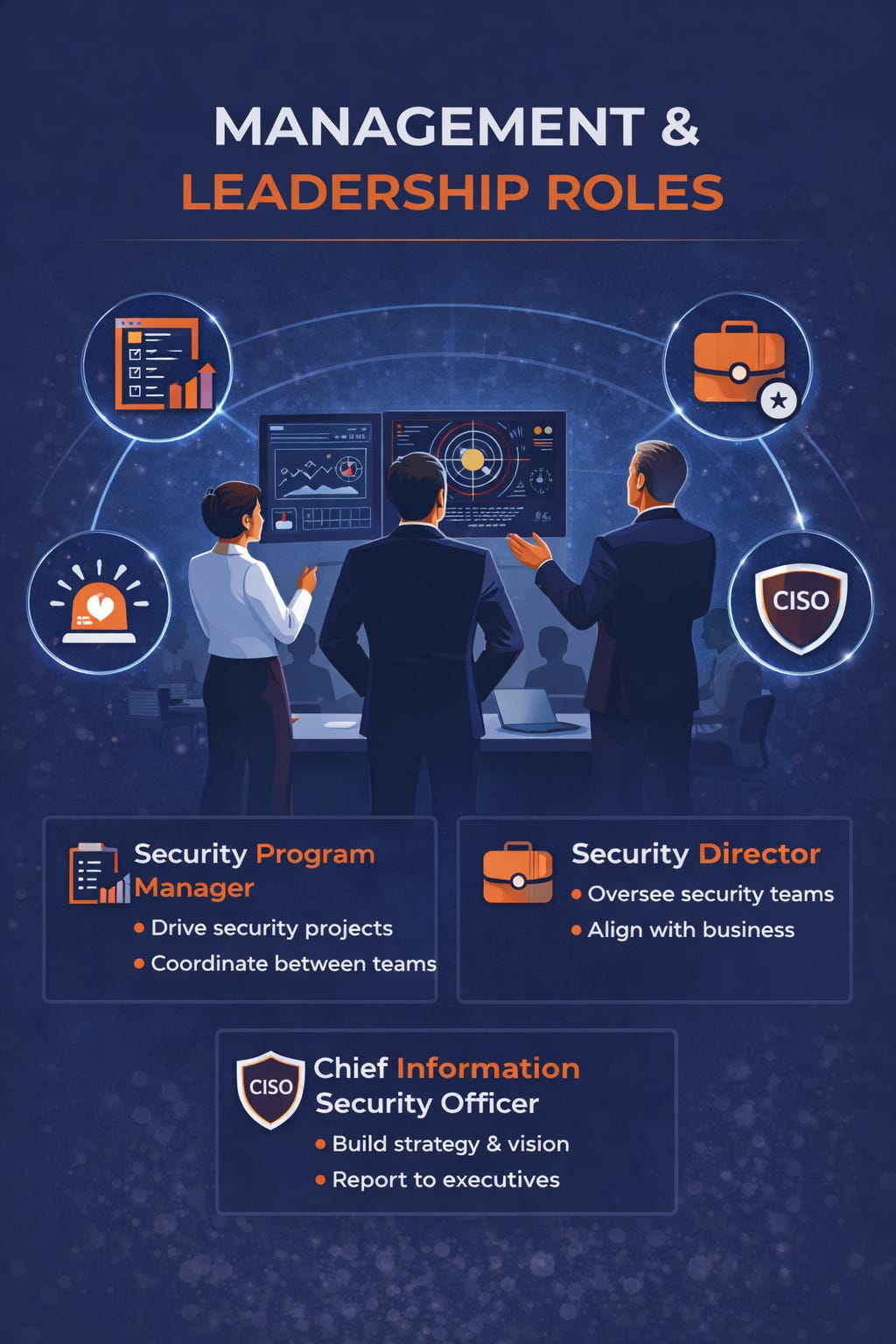
Management and leadership roles exist to coordinate efforts, allocate resources, and ensure security delivers real value to the organization.
Security Program Manager
Required Seniority: Mid → Senior
Security program managers keep security initiatives moving.
They focus on:
planning and tracking security projects
coordinating between teams
managing timelines and dependencies
ensuring initiatives deliver measurable results
They don’t usually configure tools or respond to incidents.
They make sure things actually get done.
Without program management, security efforts often stall or fail due to poor coordination, not technical limitations.
Security Director
Required Seniority: Senior
Security directors lead security teams and operations.
They sit between hands-on security work and executive leadership.
Their responsibilities include:
managing security teams
setting operational priorities
overseeing budgets and resources
ensuring alignment with business objectives
A strong security director provides clarity and direction.
A weak one creates chaos, even with talented teams.
Chief Information Security Officer (CISO)
Required Seniority: Executive / Senior
The CISO owns the organization’s security vision and strategy.
This role is about:
defining long-term security direction
communicating risk to executives and the board
balancing security needs with business goals
building and leading mature security programs
A CISO doesn’t manage firewalls or alerts.
It is a C-suite role that sits at the highest level of the organization and makes sure that the overall security strategy is aligned with the business goals.
Without effective CISO leadership, security becomes fragmented, reactive, and misaligned with reality.
Conclusion
A lot of roles, right?
Don’t worry, you don’t have to decide everything today.
What does matter is that you understand the five main paths in cybersecurity, because that decision will shape everything that comes next.
Certifications.
Skills.
Entry roles.
Even how long your journey will take.
For example:
If your goal is to become a penetration tester, it makes no sense to start with leadership-focused certifications like CISSP and position yourself as a security manager.
That mismatch costs people years of effort and thousands of dollars.
Choosing a path first makes your journey:
faster
cheaper
and far less frustrating
And here’s the good news:
In the next article, I’ll break down specific, realistic certifications for each of the five cybersecurity paths, so you know exactly what makes sense for your goal, and what doesn’t.
What Should You Learn Next?
If you’re starting your cybersecurity journey, focus on fundamentals.
You don’t need to learn everything at once.
Start with:
These concepts appear everywhere in cybersecurity.
And if you master them, you will already be ahead of most beginners.
Not sure which path fits your background?
If you are serious about breaking into cybersecurity in the next 90 days, this gives you the exact plan - by someone who became a Cybersecurity Manager at 26.
I built a 90-day plan for each of the five paths above. Instead of figuring it out yourself, get the complete system:
4.8 stars. 45 people have used it. 14-day money-back guarantee.
Ready to level up your cybersecurity skills?
💬 Which of the five paths resonates most with you? Comment below - I read every response.
❓Take the quiz to test your understanding: CybersecErich: Quiz Hub
📰Subscribe (free or paid) to get new posts straight to your inbox.
Share this with a friend studying for CISSP, or anyone curious about cybersecurity
geat content
The point about people not failing due to lack of intelligence, but lack of a plan, hits hard. Cybersecurity has plenty of opportunity, but without a clear path it’s easy to end up permanently “preparing” instead of progressing.
And with AI-driven threats and chat-based fraud accelerating, security is not just growing, it’s becoming one of the most critical and fastest-expanding fields in tech.