

Warning: List of study materials at the end of the article!
In my previous article, How to Choose the Right Cybersecurity Role Before You Waste Time and Money on the Wrong Certifications, I explained that cybersecurity isn’t one job, it’s a system with multiple career paths.
One of those paths was Security Operations (SOC).
And for many people, SOC is one of the best entry points into cybersecurity.
Why?
Because SOC roles expose you to:
Real attacks
Real systems
Real investigations
Real tools
Do you want to land your first job in cybersecurity? Comment “interview” and I’ll share a cybersecurity interview guide with you for FREE. No strings attached.
You learn faster than in almost any other junior security role.
But after choosing a path, the next logical question becomes:
“Okay… what should I actually learn now?”
Certifications are often the first thing people think about.
But certifications don’t build competence on their own.
Skills do.
If your goal is your first SOC job, these are the three areas that will increase your chances the most.
Growth tip: If you don’t want to on what to focus on, just let me know in the comments. I will help you out!
1. Networking Fundamentals
SOC analysts investigate alerts.
And most alerts involve network activity.
Suspicious IP addresses.
DNS traffic.
Authentication attempts.
Connections to unknown servers.
And to investigate something, you need to understand it first.
The good news?
You don’t need to learn everything at once.
You need the right fundamentals.
If you’re unsure where to start, I already covered the most important protocols beginners should focus on here:
👉 Top 5 most important network protocols for cybersecurity beginners
One simple truth:
Networking is the language of SOC. Make sure you can describe a three-way handshake anytime!
2. Linux and System Basics
Many security tools and enterprise systems run on Linux.
Cloud workloads? Linux.
Security appliances? Linux.
Servers? Often Linux.
You simply can’t avoid it!
However, you don’t need to become a Linux beast overnight!
You’re no administrator, you’re a SOC analyst.
You don’t need 1,000 commands.
You need a practical subset.
I explained exactly which ones matter most here:
👉 Top 5 Linux commands for an entry-level cybersecurity role
Even beginner Linux familiarity already puts you ahead of many candidates.
And because I know how it feels to be completely lost, I chose 5 Linux commands I’d start with if I were completely new to Linux.
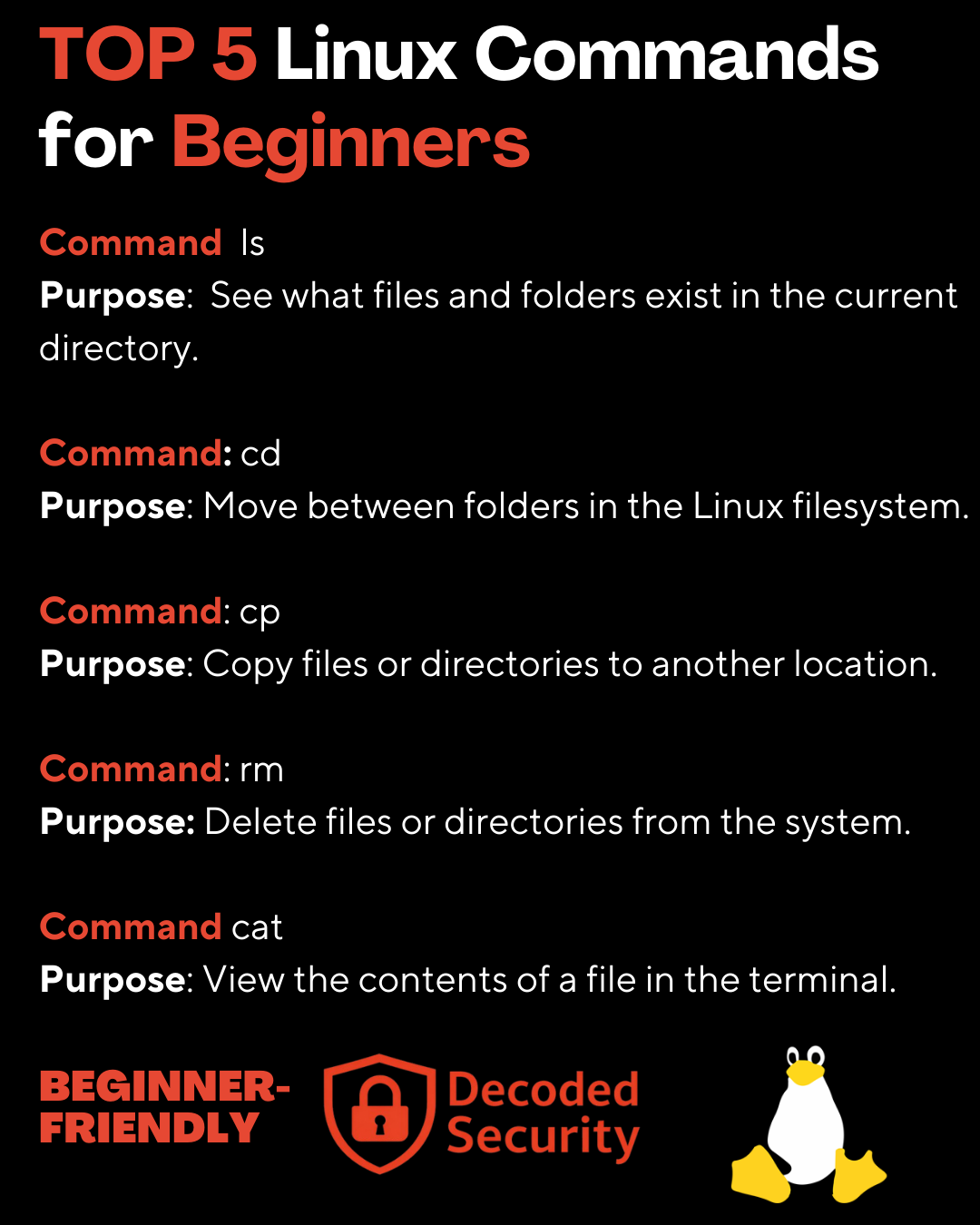
What commands would you add on the list? Let me know in the comments!
3. Hands-On Investigation Practice
This is the biggest differentiator.
Employers want evidence that you can think like an analyst.
That means:
Looking at logs
Understanding alerts
Asking questions
Connecting evidence
The employer wants proof that you know what you’re looking for.
But here is the problem. How are you going to prove experience without getting the job first?
Well, the answer is simple: A PERSONAL PROJECT.
For example:
“I created a lab and analyzed suspicious login activity.”
How? You can use Docker containers to simulate any number of computers and any network topology.
If you have no idea how to create a Docker container, I have something for you: Run Your First Docker Environment in 60 Minutes.
Don’t worry, it’s FREE.
Did you manage to run your first Docker environment? Let me know in the comments!
Cybersecurity is confusing at the beginning.
So if you feel overwhelmed, don’t worry.
That’s normal.
I was exactly where you are now.
There are countless certifications, tools, and learning paths, and it’s very easy to jump from one topic to another without clear direction.
That’s why choosing a path matters, and focusing on the right fundamentals matters even more.
If your goal is SOC roles, focus on what actually builds competence:
Networking fundamentals
Linux and system basics
Hands-on investigation practice
These skills create real momentum.
And momentum is what gets people hired.
If you ever feel unsure about what you should focus on next, you can always reach out to me. I genuinely enjoy helping people navigate the beginning of their cybersecurity journey.
If you focus on the fundamentals, stay curious, and keep practicing, you are already ahead of most beginners entering the field.
Progress beats perfection.
Keep going!
Here is your actionable checklist!
If you’re serious about landing your first SOC job, start with this:
Check Your Networking Basics
Make sure you understand IPs, DNS, and the TCP three-way handshake.Practice Linux for 30 Minutes + Create 2 Docker containers on the same network!
Start a Small Security Project
Create a lab, analyze logs, or simulate login attempts.
Your goal: something you can talk about in an interview.
“I built a lab and investigated security events.”
That sentence alone can set you apart.
Which step will you start first?
Comment: NETWORK | LINUX | PROJECT
…and I’ll share one practical tip to help you.
BONUS: List of study materials
The three areas we discussed are broad.
If you’re serious about building a career in cybersecurity, especially in SOC, you should also understand the following foundational topics.
These concepts appear constantly in real environments, certifications, and interviews.
Here are some resources to help you go deeper:
Risk Management: Risk Management: Managing risks in six steps
Basics of Virtualization: Containers vs. Virtual Machines
Quantitative Risk Analysis: Quantitative Risk Analysis: Let The Numbers Do All The Talking
Access Control: Access Controls: Who Gets the Keys?
Diffie-Hellman: Diffie-Hellman Explained Like You’re 12 (And Why Interviewers Love Asking About It)
ISO/OSI model: Understanding the ISO/OSI Model – Why is it crucial for Cybersecurity professionals?
Let’s connect
If you want to collaborate, discuss, or just geek out over virtualization and cloud security, reach out to me:
Email: erich.winkler@decodedsecurity.com
LinkedIn: Erich Winkler
Gumroad community: Decoded Security
Enjoyed this article? Like it or drop a comment. I’d love to hear your thoughts and questions!
Let’s learn and grow together!
Interview