

📘 Essential for anyone preparing for the ISC2 CC or CISSP exam
I’ve spoken with many people who passed the ISC2 exams, and I've also spoken with many who failed. And every time I meet someone who failed, I take notes.
And for some reason, this topic comes up very often. Even though it isn’t anything complex, it is absolutely essential in real-world practice.
That’s why I decided to include it in my materials and make sure that no one reading Decoded Security will fail this topic ever again.
Testing Disaster Recovery Plans
You studied disaster recovery. You know what RTO (Recovery Time Objective) and RPO (Recovery Point Objective) mean.
You understand backups, the data security lifecycle, and you can tell the difference between a hot site and a warm site.
If you’re not familiar with those terms, you can find links to my previous articles explaining all of those topics at the end of this article.
You feel ready to answer all disaster recovery questions that might come up in the ISC2 exams.
And you still might fail. And you wouldn’t be the first, nor the last.
People are usually so focused on creating disaster recovery plans and business impact analysis that they forget one crucial part.
A plan is useless unless it’s regularly tested.
And this is exactly where exam questions are designed to catch you.
Because in both the ISC2 Certified in Cybersecurity (CC) and CISSP, one principle shows up again and again:
A plan that hasn’t been tested cannot be trusted.
The hierarchy of disaster recovery testing
Both for the exams and the real-world practice, you need to know two things.
Different types of exercises to test DR plans
How to balance the assurance with the cost
As always, the more thorough you are, the more money it costs. And stakeholders won't like that.
Let’s take it from the least expensive to the most.
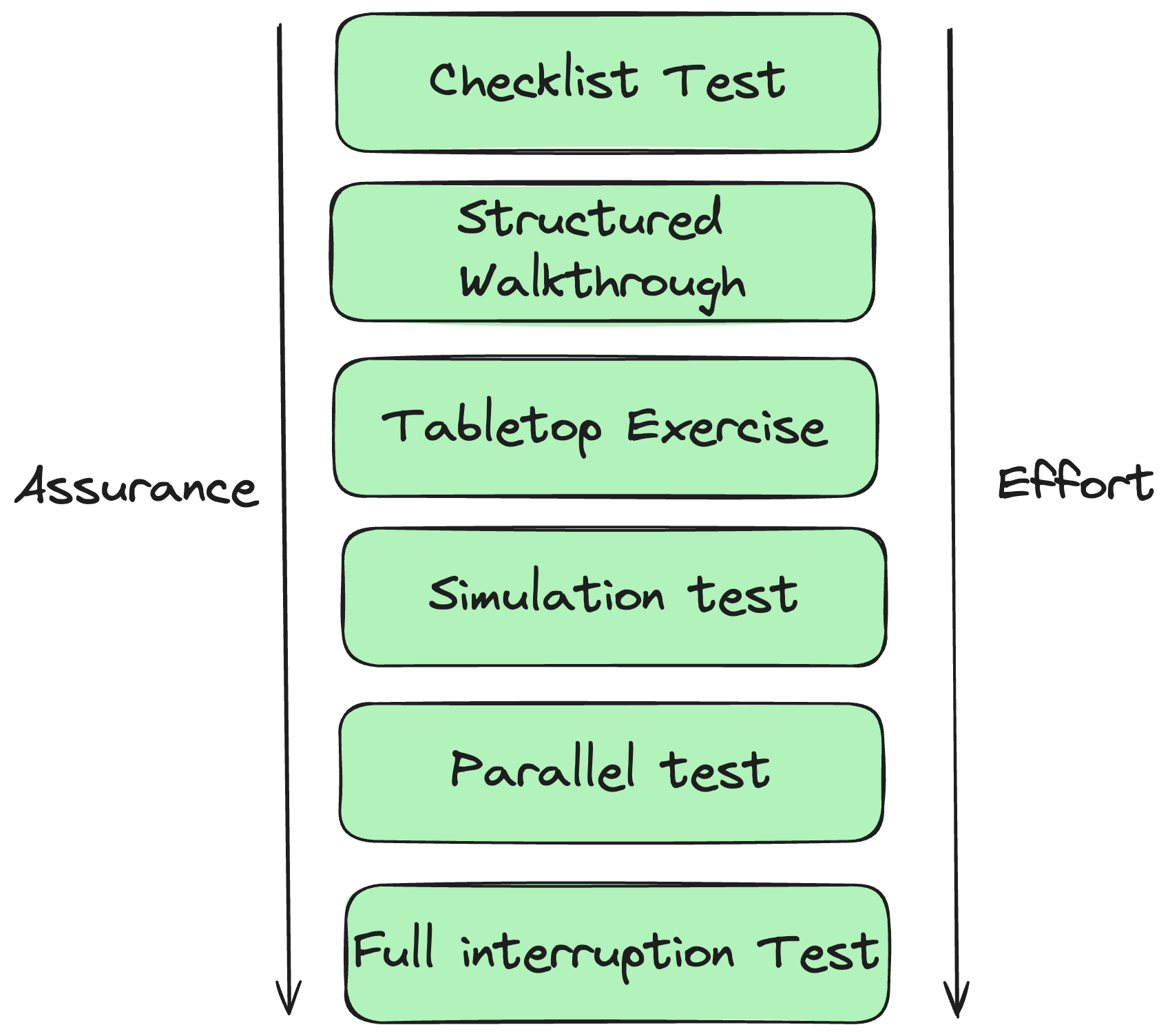
1. Checklist Test
Purpose
Validate that the disaster recovery plan is complete and up to date.
How it is performed
The DR plan is distributed to functional managers
Each manager reviews their section independently
They verify:
Contact details
Roles and responsibilities
Procedures
Feedback is collected and consolidated
The plan is updated accordingly
Benefits
Easy and fast to perform
Identifies missing steps or outdated information
Low cost, no operational impact
Drawbacks
No real execution
No validation of actual recovery capability
Gives a false sense of security
When to use
Early stages of DR planning
Regular reviews (e.g., quarterly updates)
Before more advanced testing
Exam insight: This is the weakest form of testing, but it is conveninent as it can be perform regularly without operational impact.
2. Structured Walkthrough
Purpose
Validate logical flow and completeness of the plan as a group.
How it is performed
Key stakeholders meet in a structured session
The plan is reviewed step by step
A facilitator walks the group through:
Sequence of actions
Dependencies between teams
Participants discuss:
What happens next
What might be missing
Gaps and conflicts are documented and resolved
Benefits
Identifies inconsistencies and gaps
Improves team understanding
Encourages collaboration across departments
Drawbacks
Still theoretical
No real system or process validation
When to use
After checklist review
When updating or improving the plan
Before running simulations
3. Tabletop Exercise
Purpose
Simulate decision-making during a disaster scenario.
How it is performed
A realistic scenario is introduced (e.g., ransomware, data center outage)
Participants assume their real roles
A facilitator drives the scenario forward in phases
Teams explain:
What actions they would take
Who they would contact
How decisions are made
Injects (new developments) are added to simulate pressure
Observers record gaps and decision issues
Benefits
Tests roles and responsibilities
Improves communication and coordination
Reveals gaps in procedures and escalation paths
Drawbacks
No real technical execution
Does not validate recovery time or system restoration
When to use
Training teams
Testing incident response + DR coordination
Preparation for more advanced tests
Exam trap: Remember that nothing is actually executed in this type of testing!
4. Simulation Test
Purpose
Test actual execution of disaster recovery procedures in a controlled scenario.
How it is performed
A specific disaster scenario is defined
Teams execute actual recovery procedures:
Restore systems
Recover data
Activate DR processes
Real tools and systems are used
Activities are monitored and timed
Issues (failures, delays, confusion) are recorded
Results are analyzed after the exercise
Benefits
Validates processes and responsibilities
Reveals real operational issues
Provides measurable insights (time, errors, gaps)
Drawbacks
Requires coordination and effort
May impact operations if not controlled
When to use
After tabletop exercises
When validating readiness of teams and processes
5. Parallel Test
Purpose
Validate recovery capability by running systems at an alternate site alongside production.
How it is performed
Systems are restored or activated at the alternate site
Data is replicated or restored to that environment
The alternate system runs in parallel with production
Processing is performed and results are compared
Performance and consistency are validated
Production systems remain active throughout
Benefits
Tests the infrastructure and data replication
No disruption to live operations
High level of confidence without full risk
Drawbacks
Resource-intensive
Doesn’t fully simulate real failure conditions
When to use
When testing alternate sites
Before conducting full interruption tests
In mature DR environments
6. Full Interruption Test
Purpose
Validate complete disaster recovery by switching all operations to the alternate site.
How it is performed
Production systems are intentionally shut down
Operations are switched entirely to the alternate site
All business processes run from the recovery environment
Users interact with the DR systems as if it were real production
Recovery time and performance are measured
After testing, systems are restored back to normal operations
Benefits
Highest level of assurance
Fully tests systems, people, and processes
Provides real recovery metrics
Drawbacks
High risk
Operational disruption
Expensive and complex
When to use
Mature organizations with strong DR capabilities
Critical systems requiring full validation
Infrequently (e.g., annually)
Exam insight: This provides the strongest validation and should be used only if the highest level of assurance is required.
Printable cheat sheet - perfect for the exam.

Conclusion
This is everything you need to correctly answer disaster recovery testing questions on the ISC2 Certified in Cybersecurity (CC) and CISSP exams, and more importantly, to choose the right level of assurance in real-world practice.
I have one last tip for you. Always complete the previous level before moving to the next. Each level builds on the previous one.
You review before you simulate
You simulate before you execute
You execute before you fully interrupt
Skipping levels doesn’t make you efficient. That’s a common trick in the exam.
Thank you for reading Decoded Security!
Let’s Connect
If you want to collaborate, discuss, or just geek out over networking and cybersecurity, reach out:
Email: erich.winkler@decodedsecurity.com
LinkedIn: Erich Winkler
Gumroad community: Decoded Security
Start Here: Decoded Security Roadmap
Enjoyed this article? Like it or drop a comment. I’d love to hear your thoughts and questions!
Let’s learn and grow together!
Disaster Recovery and Business Continuity - Study resources
Decoded Security Certification Hub

Pass Certifications Without Wasting Months or Spending $1,000+ on Courses


testing the plan is more important than people realize. it’s great to have a check in the box, but going through the motions makes all the difference. +1