

‼️ Warning: CC, Security+, and CISSP relevant topic!
If you are starting out in cybersecurity, you have probably heard that networking is the foundation.
That is true.
But here is what nobody tells you: knowing the attacks by name is worthless.
Exams describe scenarios. Interviewers describe situations. Log files show patterns. None of them comes with labels.
By the end of this article, you should be able to recognize the top 5 most common network attacks and how to prevent them.
In this article, I will:
Break down the 5 network attacks you will meet in exams, interviews, and real incident logs
Show you the one detail that identifies each attack, whether it appears in a scenario question or a log file
Give you the countermeasure for each one, because recognizing an attack is only half the job
Note: All of these attacks abuse features of normal network protocols. You can follow this article either way, but if you want the foundations first, start here:
First, Understand the Family: DoS vs. DDoS
Every attack in this article is a denial-of-service attack. The goal is not to steal data. The goal is to make a system unavailable to the people who need it.
There are two main types:
DoS (Denial of Service): One attacker, one source, flooding a target until it stops responding.
DDoS (Distributed Denial of Service): The same idea, but the traffic comes from thousands of sources at once. Much harder to block, because there is no single IP to filter.
Now, let’s get into the 5 attacks.
Do you find this article useful? Give it a like and help more people find it!
1. SYN Flood: The Handshake That Never Finishes
This is the most important attack on the list. If you learn only one, learn this one.
Normal TCP connections start with a three-way handshake. The client says SYN. The server answers SYN-ACK. The client confirms with ACK. Connection established.
A SYN flood abuses the politeness of that process.
The attacker sends thousands of SYN packets and never sends the final ACK.
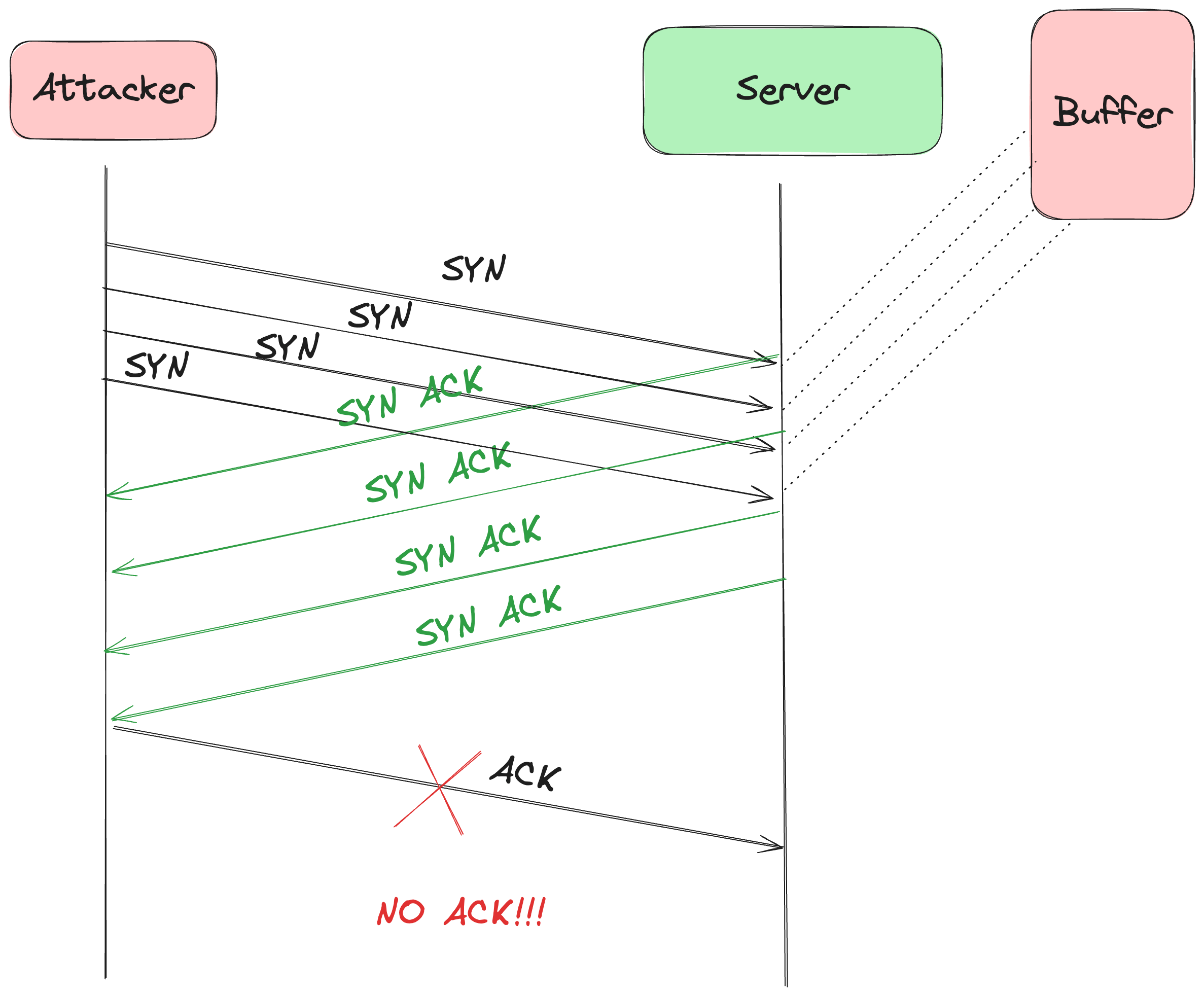
The server, being polite, holds a spot open for each half-finished handshake and waits. And waits.
Eventually, the table of half-open connections is full, and legitimate users get turned away.
The analogy: Imagine a restaurant where callers keep making reservations and never show up. Every table is “reserved.” Real customers stand outside a half-empty restaurant that they cannot enter.
Countermeasure: SYN cookies (the server does not commit resources until the handshake completes), reduced connection timeouts, and rate limiting.
If that finally made the three-way handshake click, give it a like! It tells me these breakdowns are worth writing.
2. Smurf Attack: Turning a Network Against You
The attacker sends ICMP echo requests (pings) to a network’s broadcast address. But here is the trick: the source IP is spoofed to be the victim’s address.
Every device on that network receives the ping and politely replies. To whom? To the victim. One packet from the attacker becomes hundreds of replies flooding the target.
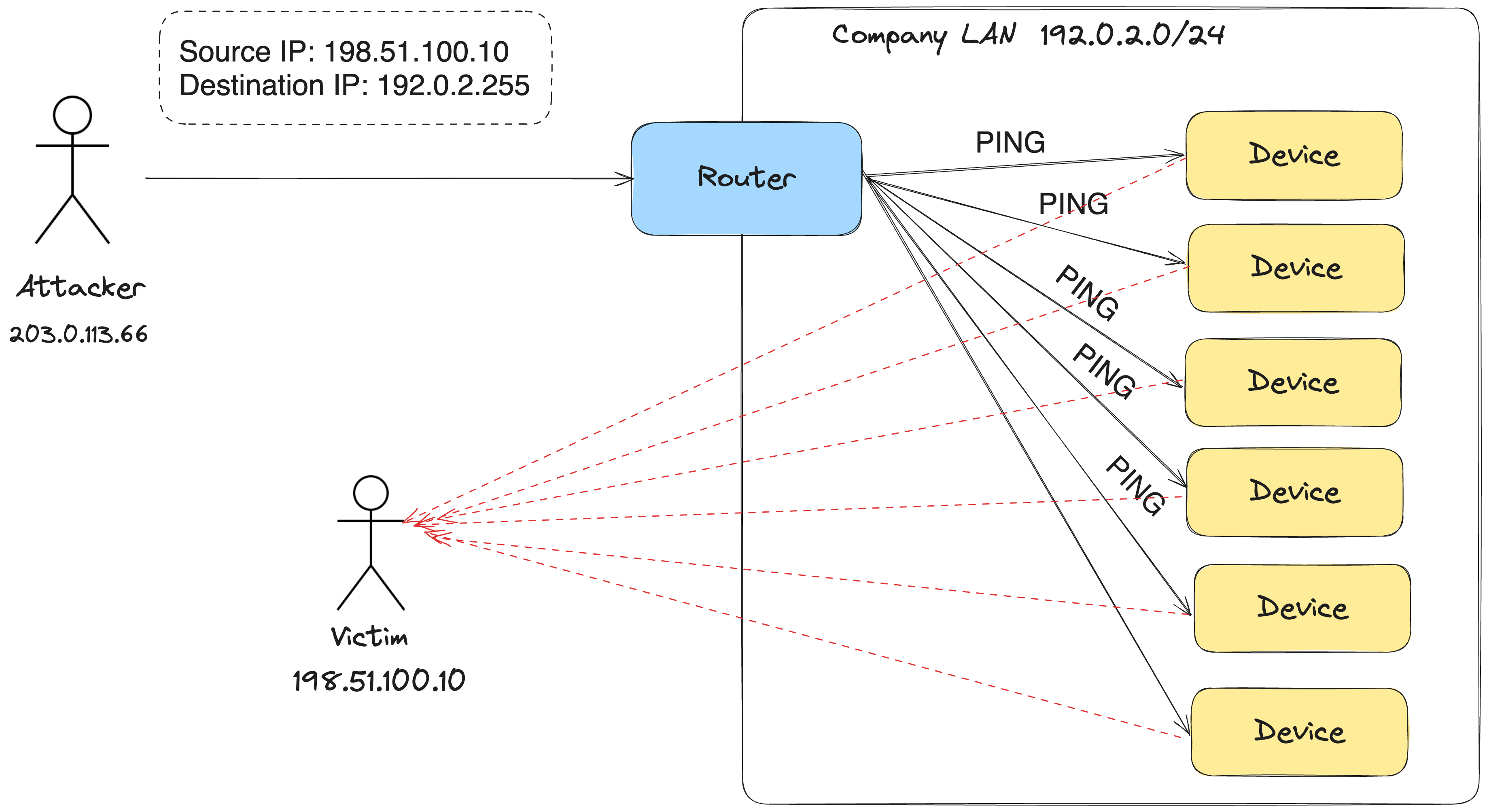
The analogy: Someone sends a letter to an entire apartment building saying “please call this number immediately” and writes your phone number on it. You did nothing, and now your phone will not stop ringing.
Scenario keywords: ICMP, broadcast address, spoofed source.
Cousin to remember: The Fraggle attack is the exact same play, but with UDP traffic instead of ICMP. Exams love testing whether you know the difference. ICMP means Smurf. UDP means Fraggle. That single word decides the question.
Countermeasures: Disable IP-directed broadcasts on routers, and configure devices to ignore ICMP requests sent to broadcast addresses.
Reading an article is one thing, actually understand the concept the other.
Test your knowledge and make sure you can recognize the most common network attacks!
3. Ping of Death: One Packet, One Crash
Not every DoS attack needs a flood. Sometimes one malformed packet is enough.
The Ping of Death sends an oversized ICMP echo request that exceeds the system's maximum. Vulnerable systems try to process it, overflow their buffer, and crash.
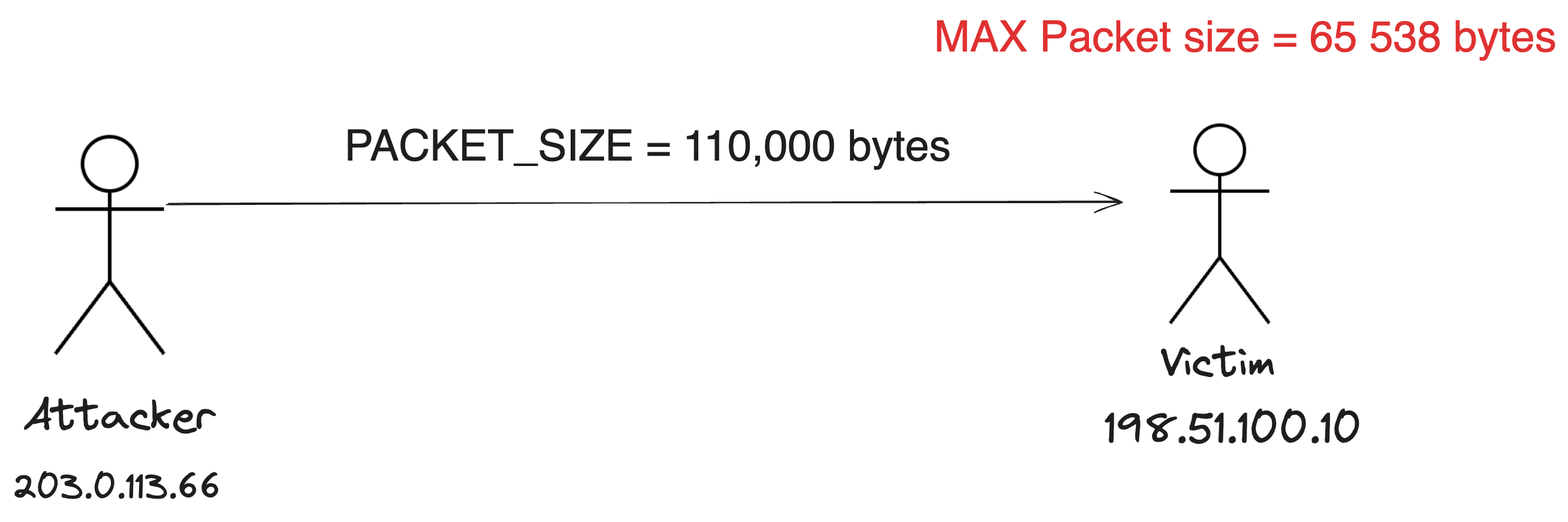
The analogy: Mailing someone a package too big to fit through their door, and the door frame collapses when they try to force it through.
Scenario keyword: oversized packet.
Countermeasures: Patching. This attack exploits a bug, not a design flaw, so modern patched systems are largely immune.
4. Teardrop Attack: Fragments That Do Not Fit
Large packets get split into fragments for transmission and reassembled at the destination. The Teardrop attack sends fragments with overlapping offsets, so they cannot be reassembled correctly.
A vulnerable system tries anyway, gets confused by the overlap, and crashes.
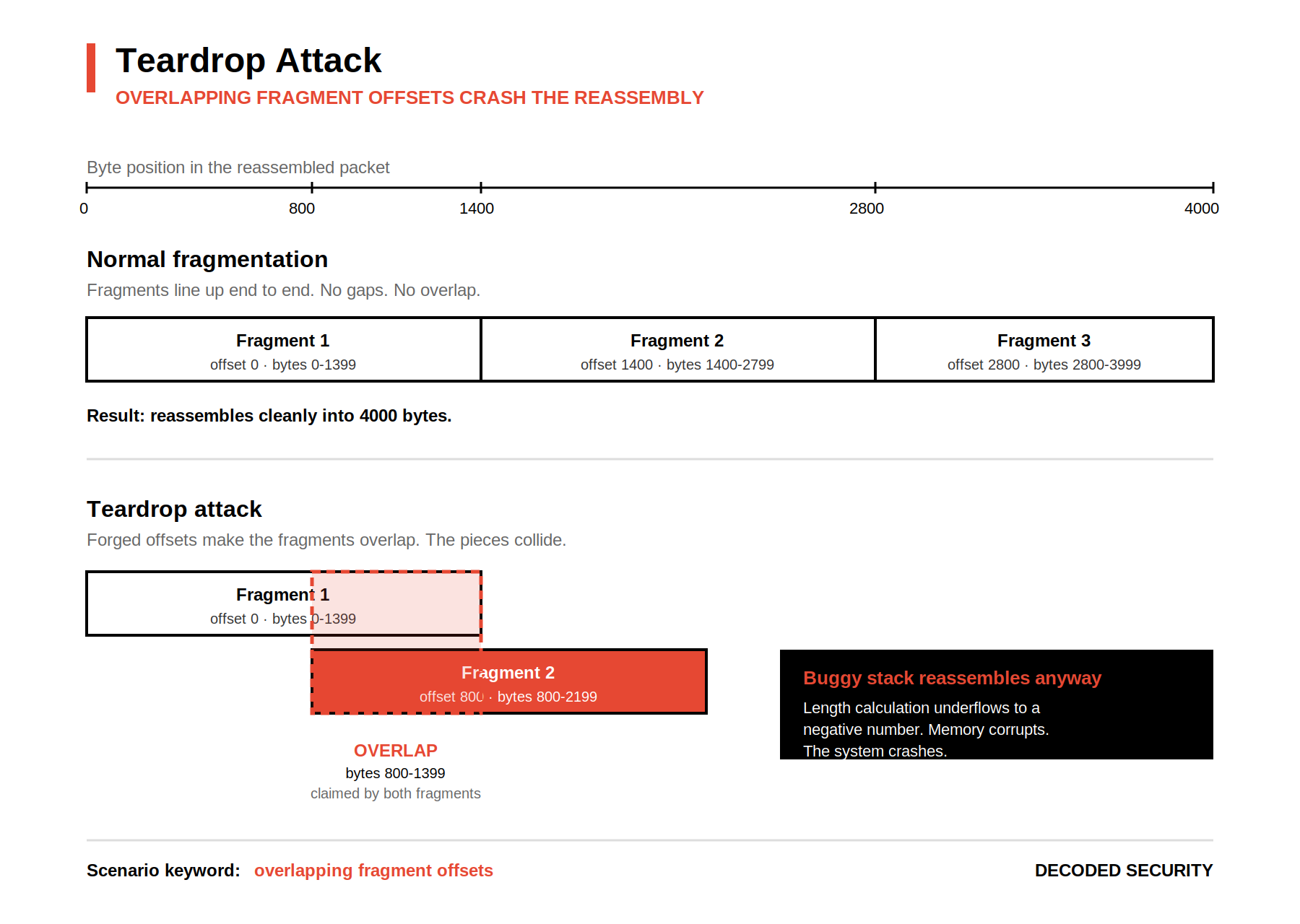
The analogy: A jigsaw puzzle where the pieces are cut to overlap each other. The picture is impossible to assemble, but the system keeps trying until it breaks.
Scenario keywords: fragmentation, overlapping fragments, reassembly.
Countermeasures: Patching again. Like Ping of Death, this exploits a bug in TCP/IP reassembly. Firewalls that drop malformed fragments also help.
5. Land Attack: The Packet Addressed to Itself
The attacker crafts a packet where the source IP and port are identical to the destination IP and port. The victim machine receives a packet that appears to come from itself, addressed to itself.
A vulnerable TCP stack processes it, replies to itself, processes the reply, and loops until it freezes.
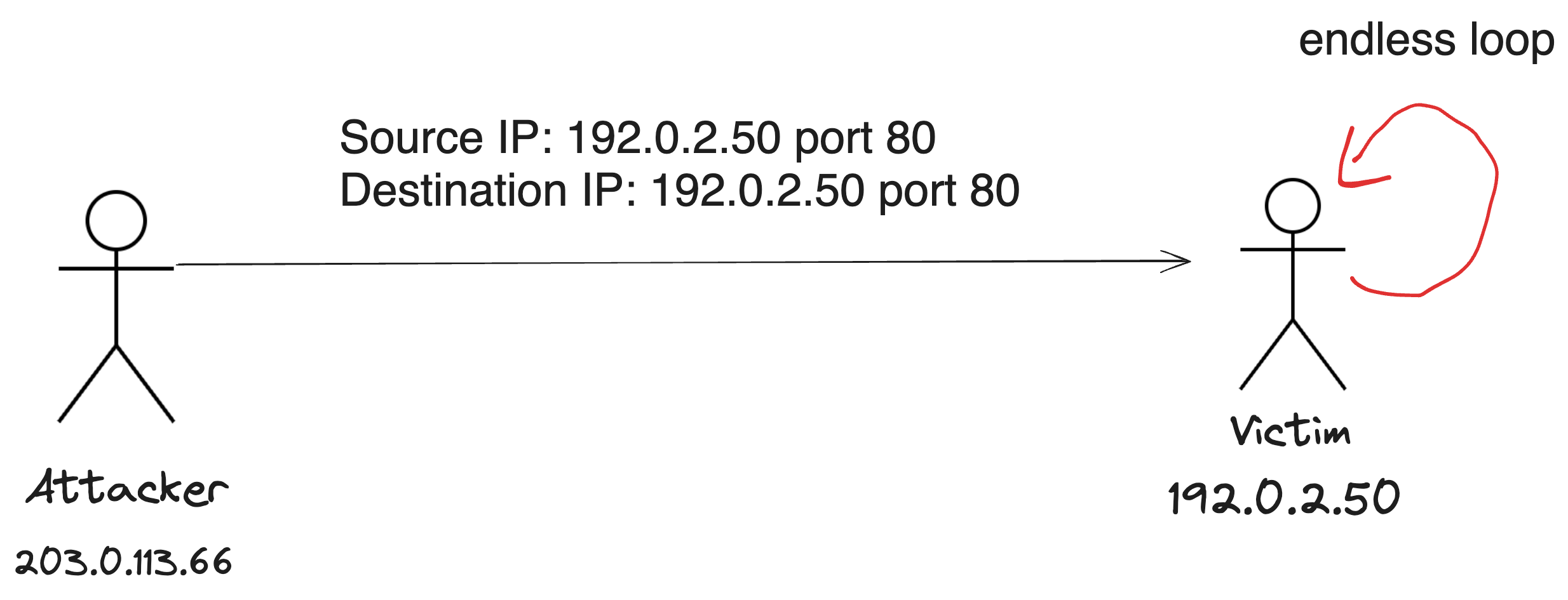
The analogy: Mailing yourself a letter that says “reply to this letter.” Forever.
Scenario keyword: identical source and destination IP and port. If you see that phrase, the answer is Land attack. Nothing else looks like this.
Countermeasures: Modern systems drop these packets automatically. Firewalls with ingress filtering block spoofed packets claiming to come from inside your own network.
Do you think you can recognize the network attacks now? Let’s find out!
Take the quiz and drop your score below!
How To Actually Remember These
Do not memorize definitions. Memorize the one detail that makes each attack unique:
SYN Flood = half-open connections
Smurf = ICMP to broadcast address (Fraggle = same but UDP)
Ping of Death = one oversized packet
Teardrop = overlapping fragments
Land = source equals destination
Exam scenarios are built around exactly these details. Spot the detail, and the question answers itself.
If you are screenshotting this list, do me one favor first: hit like so the next person studying for their exam actually finds it.
Key Takeaways
Here is what I want you to remember:
Denial of service is about availability, not data theft. That is the “A” in the CIA triad.
Understanding network protocols is the first step in understanding network attacks
DDoS is harder to stop than DoS because there is no single source to block.
Always act proactively, not reactively. Prepare for these attacks BEFORE they happen, not after.
Great! If you understand these 5 attacks, you are already ahead of most people who claim to be cybersecurity experts. But before you go, I have prepared something else for you!
Test Yourself
Here is a scenario, exam style:
A server becomes unresponsive. Logs show a massive number of connection attempts, each stuck waiting for a final acknowledgment that never arrives.
Which attack is this, and which countermeasure would you deploy first?
Comment your answer below. I read every one, and I will tell you if your reasoning would hold up on exam day.
And if you want to really test your understanding of network attacks, I prepared a CISSP-like cybersecurity quiz for you!
Take it and drop your score in the comments. I read every single one of the comments!
‼️ Continue learning ‼️
Here is the truth most beginners miss:
Networking is not one topic in cybersecurity. It is the ground everything else stands on. Firewalls, attacks, monitoring, and incident response. None of it makes sense until the network underneath makes sense.
You just learned 5 attacks. Here is how to build on that, in order:
Top 5 most important network protocols for cybersecurity beginners
7 Networking Questions That Instantly Expose Beginners in Cybersecurity Interviews
Wi-Fi Security for the CISSP candidates: Here Is What Actually Matters
The Complete Guide to Firewall Types: From Packet Filters to Next-Gen
And if you are still asking the real question, “out of everything in cybersecurity, what actually matters?”, I answered it in one place.
I put together a free 80-page guide covering the 10 cybersecurity concepts behind 90% of entry-level interview questions. Download it here: Top 10 Cybersecurity Concepts
Let’s Connect
If you want to collaborate, discuss, or just geek out over networking and cybersecurity, reach out:
Email: erich.winkler@decodedsecurity.com
LinkedIn: Erich Winkler
Gumroad community: Decoded Security
Start Here: Decoded Security Roadmap
Enjoyed this article? Like it or drop a comment. I’d love to hear your thoughts and questions!
Let’s learn and grow together!
This was very helpful, thanks a lot