

What does 99.9999% availability actually mean ?
Cloud Providers often use the term “the nines“
An application that has “2 nines” availability must be available 99% of the time. This means in a typical month, it can be down for 432 minutes and still meet the 99% available goal.
So, here is the list of “The Nines.”
99% → 432 minutes of Monthly Outage
99.9% → 43 minutes of Monthly Outage
99.99% → 4.3 minutes of Monthly Outage
99.999% → 26 seconds of Monthly Outage
99.9999% → 3 seconds of Monthly Outage
So here is how it works.
When your cloud provider says:
“We offer 99.99% uptime.”
What they really mean is:
“We can be down for 4 minutes every month and still meet our contractual obligation.”
The marketing sounds incredible, but the reality is simple:
Every extra nine costs money and shifts responsibility away from the provider and onto you.
Do you find this article helpful? Let me know in the comments!
Why does it matter?
Maybe you’re wondering why I am talking about it.
My newsletter is focused on Cybersecurity.
Well..Exactly!
Cybersecurity is mainly about assigning responsibility!
And that is what SLA is all about.
While managing vendors, cloud services, or any outsourced environment, your SLA is your security boundary.
So let me start at the beginning
📤 Know someone who still don’t believe that Cybersecurity isn’t just about firewalls? Send this their way.
SLA..What is it?
A Service Level Agreement (SLA) is a contractual agreement that defines the minimum level of service a provider promises to deliver, and the exact responsibilities you agree to take on.
Most CISSP candidates think of SLAs as “availability numbers,”
but that’s only one small piece.
In reality, an SLA is:
a risk-management document,
a responsibility map,
and your last line of defense when something goes wrong.
Think of it this way:
Your architecture defines how your system should work.
Your SLA defines who takes the blame when it doesn’t.
And here’s the uncomfortable truth:
Security incidents become legal incidents very, very quickly.
Do you need a complete Checklist of what a Security focused SLA should cover?
You can download it here for FREE.
That’s why CISSP Domain 1 emphasizes understanding SLAs not as IT contracts, but as security governance tools. They determine:
Who owns the data
Who must secure the infrastructure
Who performs backups
Who reports incidents
Who pays when something breaks
Who must remain compliant with laws and standards
Who carries the liability during outages or breaches
If you don’t know these responsibilities, you can’t manage risk, and the provider will happily let you assume more than you should.
Preparing for the CISSP exam?
A Service-level agreement is just one small piece of the puzzle of the CISSP exam.
If you want a structured way to master Domain 1 of the CISSP exam, I’ve created something for you.
My CISSP Domain 1 Checklist provides clarity and focus on everything that truly matters for the exam and real-world practice.
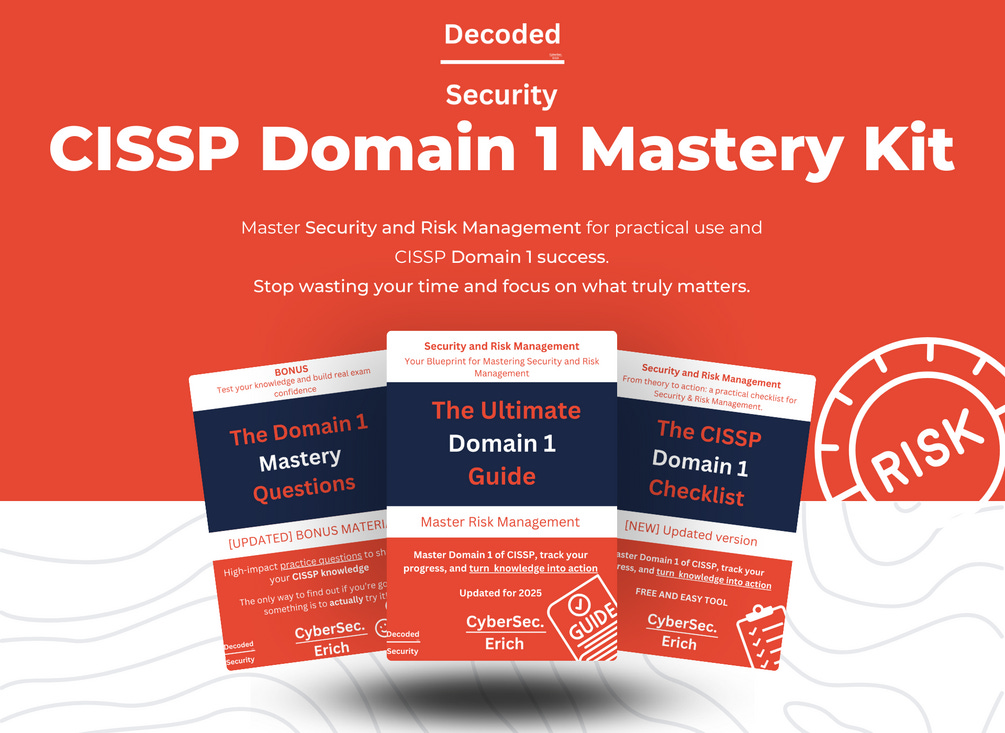
➡️ Download it here and stop wasting time on scattered study materials.
So what actually belongs inside a security-focused SLA?
A proper SLA covers the full lifecycle of confidentiality, integrity, and availability (CIA) and what happens when any of those fail.
Let’s take a look at 7 crucial topics you need to cover in your SLAs.
Don’t know what the CIA Triad is? Don’t worry, I got you covered!

1. Availability (The Nines)
Uptime %, measurement method
Maintenance windows
Service credits
Exclusions (force majeure, scheduled downtime)
2. Data Ownership
Who owns the data
Access rights
Backup retention
Data return & deletion process
3. Security Responsibilities
Patching
IAM
Logging & monitoring
Encryption + key management
Vulnerability scans / pentests
Notification rules
4. Incident Response
RTO / RPO
Severity levels
Escalation path
Provider’s reporting timeline
5. Compliance Requirements
Which laws/standards apply (GDPR, ISO, SOC2, NIS2)
Provider’s audit obligations
Your audit rights
Evidence/request process
6. Performance Metrics
Response times
Throughput limits
Resource guarantees (CPU, IOPS, bandwidth)
Degradation thresholds
7. Exit Strategy
Contract termination terms
Data migration support
Format of data export
Cost & timeline for offboarding
How fast service must be restored
If these are missing, you’re not in control of your own crisis.
Interested in Cloud Computing? Don’t miss one of my previous articles!

Conclusion
If you’re reading this, congratulations! Now you understand that Cybersecurity is about assigning responsibilities and what to look for in your contracts!
SLAs aren’t just boring contracts full of legal jargon, they are your security boundary, your risk-transfer tool, and your accountability map.
Understanding the nines, the shared responsibilities, and the seven crucial SLA topics lets you:
Know who is responsible for each part of your environment
Protect your organization from avoidable data loss and downtime
Ensure regulatory compliance and minimize liability
Make informed decisions about outsourcing and cloud adoption
From a CISSP perspective, an SLA is as much about governance and risk management as it is about uptime numbers.
Rule of thumb: If it’s not written in the SLA, it’s your problem.
But if you need a step by step instructions, I created a detailed FREE checklist for you.
Read it carefully, negotiate it wisely, and treat it as a core part of your security strategy, not just a checkbox in your contract.
Ready to level up your cybersecurity skills?
💬Comment below and tell me what your experience with SLAs is
❓Take the quiz to test your understanding: CybersecErich: Quiz Hub
📰Subscribe (free or paid) to get new posts straight to your inbox.
Share this with a friend studying for CISSP, or anyone curious about cybersecurity.
sry! it is this one that I talked about SLA!
https://open.substack.com/pub/yutafromjapan/p/beyond-the-zero-sum-the-great-paradox?r=5zimtx&utm_campaign=post&utm_medium=web
we share the same topic!!
https://substack.com/@yutafromjapan/note/p-167569291?r=5zimtx&utm_source=notes-share-action&utm_medium=web