

If you’re preparing for CC or CISSP, incident response is one of those topics everyone thinks they understand, until the exam or interview question forces you to explain it clearly.
📘 Essential for anyone preparing for the ISC2 CC or CISSP exam.
CISSP doesn’t test tools. Interviews don’t care about dashboards.
They test whether you understand the purpose, importance, and structure of incident response at a professional level.
And I will get you ready for those questions!
What Is Incident Response?
Incident response (IR) is the structured approach an organization uses to detect, analyze, contain, eradicate, and recover from security incidents.
But that definition misses the point.
At its core, incident response exists to answer one question:
“How do we stay in control when something has already gone wrong?”
It assumes failure. It assumes compromise.
And it focuses on damage control, decision-making, and recovery, not prevention.
The Purpose of Incident Response
The purpose of incident response is not to prevent incidents.
That’s a common misunderstanding.
Incident response exists to:
Limit business impact
Protect critical assets and data
Preserve evidence and accountability
Enable fast, informed decisions under pressure
Restore trustworthy operations
In other words:
Incident response turns chaos into a managed situation.
Without it, every incident becomes an improvisation, and improvisation under stress is how small incidents become disasters. → I need you to remember this!!
There is no quicker way to learn than connecting with people who are already where you want to be!

The Phases of Incident Response - Structure
For CC and CISSP, incident response is understood as a lifecycle, not a single action.
Each phase has a specific purpose, and mixing them up is a common exam and interview mistake.
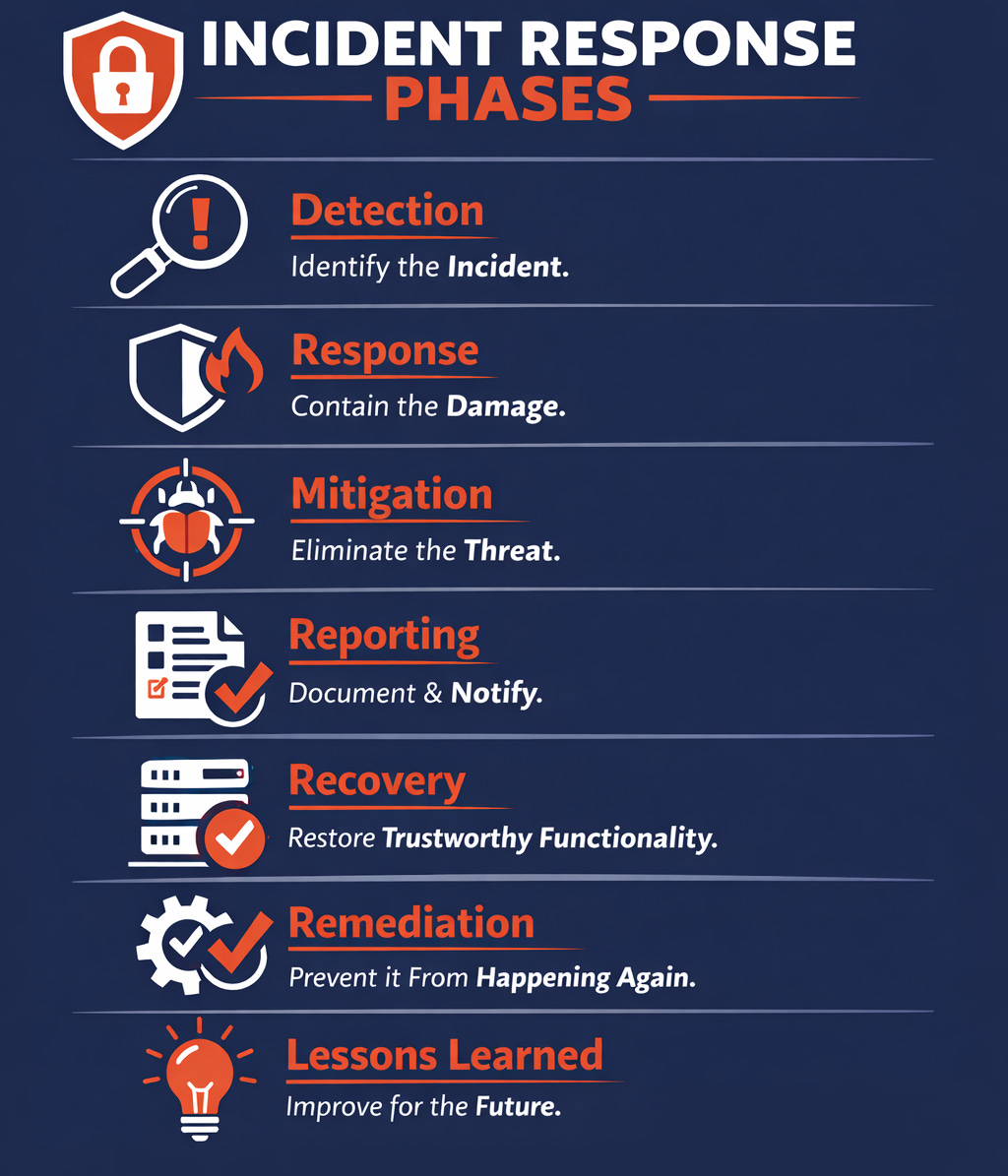
1. Detection & Identification
This phase answers one question:
“Do we have an incident?”
Detection can come from:
Technical sources (SIEM, EDR, monitoring systems)
Human sources (employees, administrators)
Third parties (partners, service providers)
At this stage:
You do not fix anything
You do not jump to conclusions
You confirm that an event qualifies as a security incident
📌 Exam trap: Detection is not a response. Identifying an incident does not mean containing it.
2. Response
This phase answers:
“How do we stop the damage from spreading?”
Containment focuses on:
Isolating affected systems
Preventing further compromise
Limiting business impact
Speed matters more than perfection.
📌 CISSP mindset: Temporary containment is acceptable if it prevents escalation.
3. Mitigation
This phase answers:
“How do we properly eliminate the threat?”
Mitigation focuses on removing adversarial control from affected systems.
It includes:
Removing malware
Eliminating persistence mechanisms
Closing exploited vulnerabilities
The mitigation phase ends when affected systems, while still isolated from production networks, are free from adversarial control.
📌 Key exam point: Clean systems are not yet trusted systems.
Do you know anyone struggling with these concepts? Send it their way and help them out!
4. Reporting
This phase answers:
“What must be documented, and who needs to know?”
Proper reporting ensures legal, regulatory, and executive readiness.
An incident report includes:
Summary of the incident
Indicators of compromise
Related incidents
Actions taken
Chain of custody for all evidence
Impact assessment
Identification and comments of incident handlers
Next steps to be taken
📌 Interview insight: If it’s not documented, it didn’t happen.
5. Recovery
This phase answers:
“Can we trust these systems again?”
Recovery aims to restore full, trustworthy functionality.
It requires:
Significant testing
Verification that affected systems are truly trustworthy
Proper configuration to support business processes
Confirmation that no compromises exist in those processes
Recovery is complete only when systems are both operational and trustworthy.
📌 Exam trap: Availability alone does not equal recovery.
6. Remediation
This phase answers:
“How do we make sure this never happens again?”
Remediation focuses on long-term risk reduction.
It includes:
Identifying control gaps
Deciding which controls must be implemented or modified
Remediation occurs in two phases:
Controls are put in place
Controls are later reviewed to determine if they should become permanent
📌 CISSP principle: Remediation addresses root causes, not symptoms.
7. Lessons Learned
This phase occurs once the incident is closed.
It answers three questions:
What happened?
What did we learn?
How can we do it better next time?
Lessons learned drive:
Process improvements
Training updates
Policy and control enhancements
📌 Professional mindset: Every incident should reduce future risk.
Conclusion
If you’re reading this, congratulations!
You’ve just taken another solid step in your cybersecurity journey!
Incident response is one of those topics that looks simple on the surface, but quickly exposes gaps in understanding during exams and interviews.
By now, you should have a clear mental model of why incident response exists, how the phases fit together, and how ISC² expects you to think about it.
Of course, knowing the theory alone won’t pass the exam or land you the role, but it puts you in a much stronger position than most candidates.
Remember: Clarity builds confidence.
And confidence, especially in exams and interviews, is often the deciding factor.
And if you want a complete guide on how to prepare for your first interview and land a job in cybersecurity I got you covered again: The 90-Day Cybersecurity Job Blueprint. (Secret discount for Decoded Security subscribers already applied!)
Thank you for reading Decoded Security.
I’m looking forward to your questions, comments, and discussions below.
Exam & Interview tips
For exams and interviews, remember this:
Detection ≠ Response
Containment ≠ Eradication
Recovery ≠ Remediation
Lessons learned ≠ Blame
Incident response is about controlled decision-making under pressure, not technical heroics.
Let’s connect
If you want to collaborate, discuss, or just geek out over virtualization and cloud security, reach out to me:
Email: erich.winkler@decodedsecurity.com
LinkedIn: Erich Winkler
Gumroad community: Decoded Security
Enjoyed this article? Like it or drop a comment. I’d love to hear your thoughts and questions!
Let’s learn and grow together!
Ready to level up your cybersecurity skills?
💬Comment below and tell me what your experience with SLAs is
❓Take the quiz to test your understanding: CybersecErich: Quiz Hub
📰Subscribe (free or paid) to get new posts straight to your inbox.
Share this with a friend studying for CISSP, or anyone curious about cybersecurity