

If you have spent more than a week studying cybersecurity, you have heard three words over and over.
OWASP Top 10
It shows up in job interviews. In study guides. In LinkedIn posts. In tool documentation. In your CISSP prep. It shows up everywhere.
The funny thing is, most people who claim it's important have no idea why it is actually useful. They just repeat it like a broken gramophone because they want to sound like an expert.
And maybe that’s why it took me so long to figure out how useful it is.
So let me explain it to you in a way that I wish someone had explained it to me at the beginning.
Here is what you’ll learn today:
What the OWASP Top 10 actually is
Why it is different from what you think
Why the whole industry rallies around it it
How to actually use it as a beginner
How to talk about it in an interview so you stand out
Shall we?
What Is the OWASP Top 10?
Let’s start from the beginning.
OWASP is the Open Worldwide Application Security Project. It is a nonprofit community, not a company trying to sell you something.
The OWASP Top 10 is their flagship publication:
A regularly updated list of the ten most critical security risks facing web applications, based on real-world data from thousands of applications and breaches.
Read that definition again, because two words in it do all the heavy lifting.
“Regularly updated.” This is not carved in stone. It changed from the 2021 version to the newest 2025 version, and it will change again. Because attackers move, and the way we build software moves.
“Real-world data.” It is not somebody’s opinion about what feels dangerous. It is a ranking built from evidence, from what is actually going wrong out there.
So the plain-English version is this: every few years, a global community looks at where organizations are actually getting hurt, and publishes the ten risk categories doing the most damage right now.
How is it different from what you think
Most beginners and so-called experts start focusing on the categories. They test people to see if they can recite them in the interview.
But the categories are not the point of the list. The categories might change, but what the list represents stays the same.
And I hate to say this, but most people focus on the categories rather than what the list represents and how to use it to actually improve the organization's security posture.
So if I want you to remember one thing from this article, it is this:
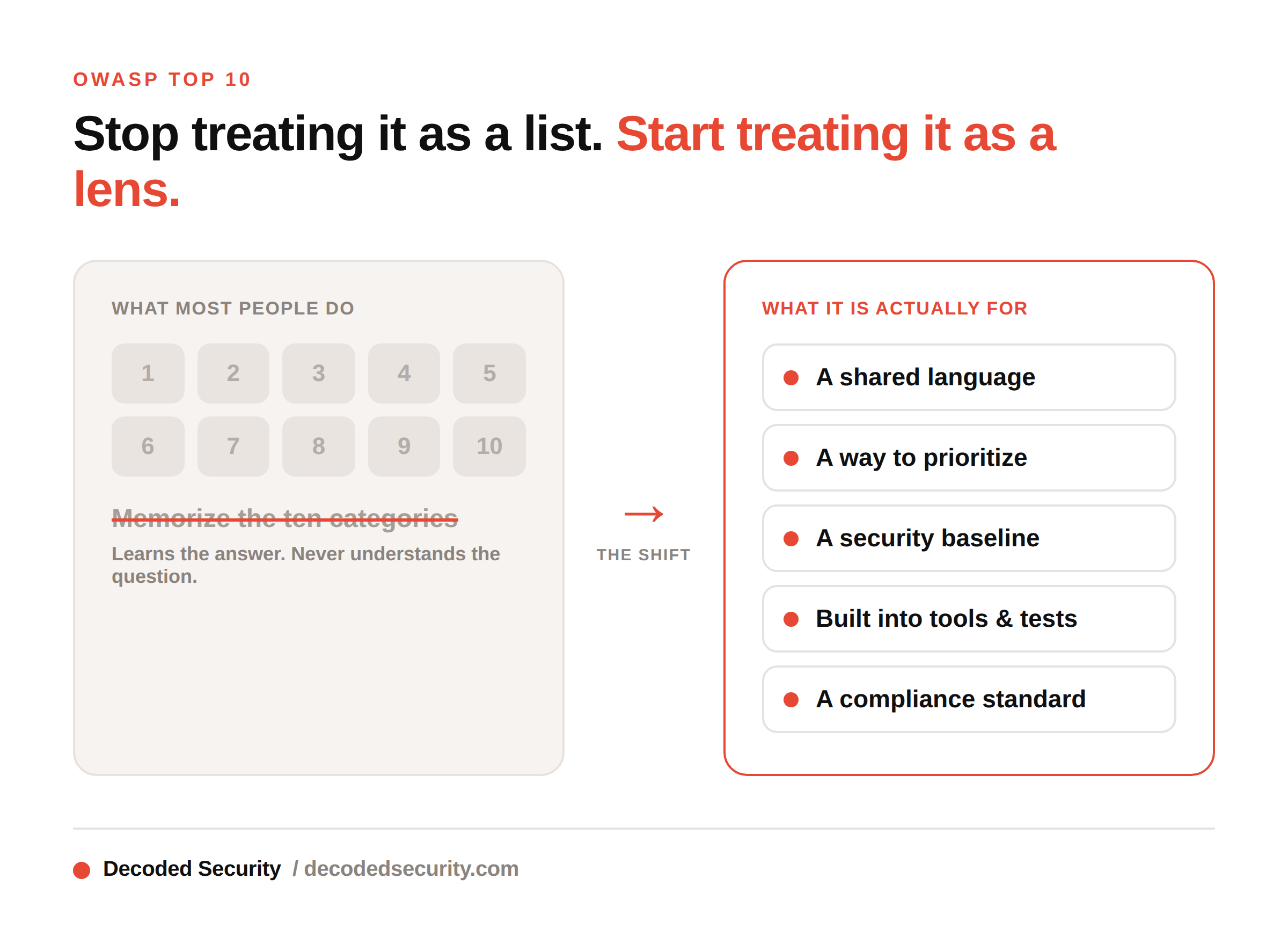
The OWASP Top 10 is not a list to memorize. It is a way of thinking about risk that the whole industry agreed to share.
Why does the whole industry rally around it
I just told you what the OWASP Top 10 isn’t. So now let’s take a look at what are the actually benefits it brings that you SHOULD remember as a cybersecurity professional.
So why is the OWASP Top 10 so important?
1. It gives everyone a shared language.
A developer in Berlin, an auditor in Toronto, and a CISO in Singapore can say “we have an access control problem” and instantly mean the same thing.
Before a common reference existed, every team described risk in their own words, and nobody could compare notes.
The Top 10 is the vocabulary that lets security people talk to each other without translation.
2. It turns an impossible problem into a priority list.
There are thousands of ways an application can be insecure and you can’t possibly handle all of them.
The OWASP Top 10 gives us risk-based prioritization, and it is the core of the entire security profession.
Remember: Security professional shouldn’t just implement security controls aimlessly.
3. It gives us baseline
No serious organization treats the Top 10 as “do these ten things and you are secure.” It is the baseline that we should focus on with the highest priority.
If you cannot even address the ten most common risks, you have no business worrying about advanced threats.
It is the minimum bar of awareness, which is exactly why it is everywhere.
Thousands of ways to be insecure, and no clue where to start. The OWASP Top 10 exists to answer one question: What do I fix first?
4. It is built into your tools and your tests.
This took me a while to figure out but most security scanners (the tools that automatically check your code and your running apps) label what they find by OWASP category.
Penetration testers scope their work around it and map every finding back to it in their reports.
So even when nobody says the words out loud, the tools and the tests are already speaking Top 10.
5. It has become a compliance standard.
Open a vendor security questionnaire, a client contract, or a framework like PCI DSS, and you keep running into the same line: “must address the OWASP Top 10.”
In other words, It is now something auditors, clients, and regulators expect you to have handled.
Notice the pattern.
Not one of these five requires you to recite the ten categories from memory. Every single one treats the list as a standard, a baseline, and a shared language.
That is the whole point.
Conclusion
This article has only one goal. Explain that the OWASP TOP 10 shouldn’t be a list that people recite, but much rather a reference model that can change over time.
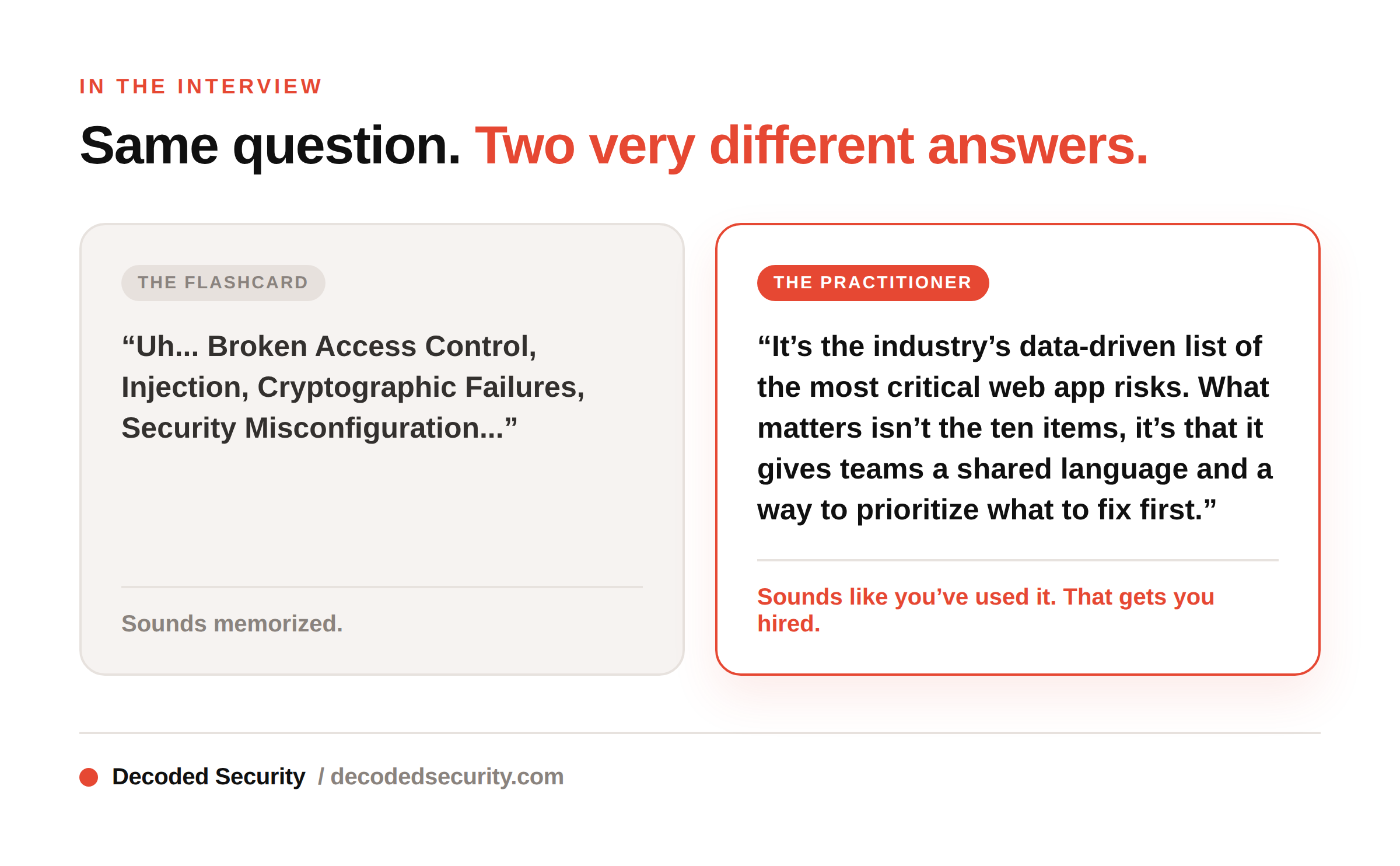
And trust me, if someone asks you about it in an interview and you’ll tell them how it’s actually used in the real practice instead of naming the categories, you will make much better impression.
If I can give you a piece of advice, do this 3 things:
Learn the "why," not the "what."Ask the question: what damage does it cause, and why is it still on the list after twenty years?
Use it as a lens, not a list. Connect it to what you already know, access control, authentication, data protection, and you'll see it is just your fundamentals breaking in the real world.
Then turn the news into a game: Next time you read about some breach, try to assign the breach to the right category. It is a simple excercise that you can do on your way to work.
Here is how you should describe the OWASP Top 10 from now on: The OWASP Top 10 is the industry's data-driven list of the most critical web application risks. What makes it valuable isn't the ten items. It's that it gives teams a shared language and a way to prioritize what to fix first.
Let’s Connect
If you want to collaborate, discuss, or just geek out over networking and cybersecurity, reach out:
Email: erich.winkler@decodedsecurity.com
LinkedIn: Erich Winkler
Gumroad community: Decoded Security
Start Here: Decoded Security Roadmap
Enjoyed this article? Like it or drop a comment. I’d love to hear your thoughts and questions!
Let’s learn and grow together!
I really like the lens vs list way of seeing it. We hear about the Top 10 all over the place, but mostly like a list indeed. I swear by the project and think they deserve much more than being a list! Have you any experience with the OWASP proactive controls? They are gold really, but rarely talked about.