

Now that you've become an expert on encryption in the previous articles, it's time to take a look at another crucial concept used in cybersecurity.
At first glance, hashing might look similar to encryption — both transform data into a different format but serve very different purposes.
🧩 What is Hashing?
Hashing is a one-way process that turns any input (a message, file, or password) into a fixed-length output called a hash. Unlike encryption, you can’t reverse a hash back to the original input. It’s meant to be irreversible.
Example:
1. Plaintext = Cybersecurity. Plaintext is an input for the hash function.
2. Hash = f1d2d2f929. No matter what input you'll give to the hash function it will always be the same length.

Hash function
A good cryptographic hash function has these essential properties:
🔁 Deterministic – Same input = always the same output.
📏 Fixed Length Output – No matter the input size, the hash is always the same length.
🧩 Pre-Image Resistance – You can’t figure out the original input from the hash.
🧨 Collision Resistance – It’s very hard to find two different inputs that produce the same hash.
🔀 Avalanche Effect – A tiny change in input = a totally different hash output.
🔒 So, What Is It Used For?
Great, if you’re new to cybersecurity, you’re probably confused right now. I just told you a bunch of definitions that don’t make any sense to you. And that’s okay; let me help you out by giving you real-life use cases for which hashing is crucial.
✅ Password Storage – Instead of storing your actual password, websites store its hash. Even if hackers get access, they don't have the real passwords.
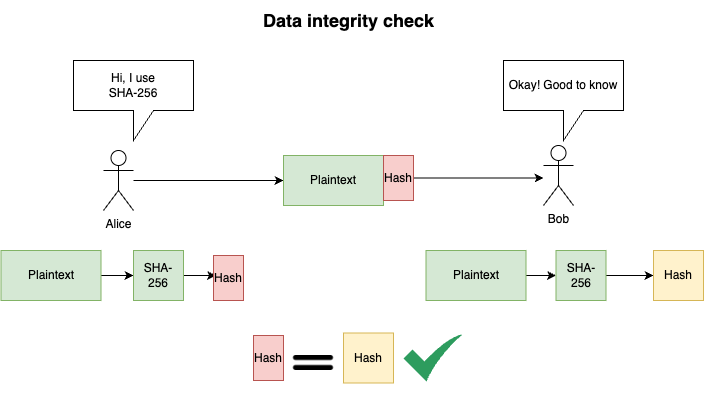
✅ Data Integrity Checks – You can hash a file before and after transmission. If the hash is the same, the file wasn’t tampered with.
✅ Digital Signatures – Hashing plays a key role in ensuring that data hasn’t changed.
🧪 Example: Verifying Message Integrity with Hashing
Alice wants to send a message to Bob and make sure no one modifies it during transmission.
Alice tells Bob which hash function she will use (e.g., SHA-256).
She generates a hash of her message.
Alice sends both the message and the hash to Bob.
Bob receives the message and uses the same hash function to generate a hash from the message he received.
He compares his hash to Alice’s hash.
✅ If the hashes match, the message wasn’t changed.
❌ If they don’t match, the message was tampered with during transmission.
🧠 Hashing vs Encryption — What’s the Difference?
Let’s summarize the biggest differences between encryption and hashing:
Reversibility
Encryption is reversible — if you have the correct key, you can decrypt the data and get back the original.
Hashing is one-way — once data is hashed, you can’t turn it back into its original form.
Purpose
Encryption is used to protect the confidentiality of data.
Hashing is used to ensure integrity — making sure data hasn’t been altered.
Use of Keys
Encryption requires keys (for both encryption and decryption).
Hashing doesn’t use keys — the same input always gives the same output.
Output
Encryption outputs ciphertext — it looks like gibberish but can be decrypted.
Hashing outputs a fixed-length string (the “hash”) that uniquely represents the input.
Common Use Cases
Encryption: Secure communication, encrypted files, VPNs.
Hashing: Password storage, file integrity checks, digital signatures
Conclusion
Understanding both hashing and encryption is crucial for any Cybersecurity specialist. I hope this post helped you to understand the basics of hashing and what it is used for.
And if you’ve made it this far — congratulations! 🎉 You now know enough to tackle many questions in entry-level cybersecurity certifications.
But there’s still more to learn — and I’ve got you covered.
👉 Make sure to follow me so you don’t miss the next posts in this series!
📩 Subscribe to my Patreon for free so you won’t miss the next posts — especially if you’re just starting your journey into cybersecurity!