

The timeline said the crime happened five hours earlier than it did.
Nobody lied. Nobody tampered with the evidence. One timestamp was converted to local time twice, and the whole timeline moved.
The examiner who made that mistake caught it himself. His name is Jeff Proctor. He’s a police officer and digital forensics examiner at the Elizabethtown Police Department, and he works with evidence from phones and computers every day.
A few weeks ago, I asked you to send him your questions. You sent them here, by email and on Discord. Jeff answered five of them in writing.
If you work in a SOC or in incident response, or you’re studying for the CC or CISSP, this is how evidence really works. Not the TV version, where someone types for ten seconds and says “I’m in.”
His answers are below, word for word. After each one, I added what I take from it, because most of this applies far beyond police work.
Got a follow-up question for Jeff after reading? Leave it in the comments. I am sure Jeff will be happy to respond!
1. Devices handled by others
When a device has already been handled or used by other people before it reaches you, what can you still rely on, and how do you work around the gaps? How does that play out in a real investigation?
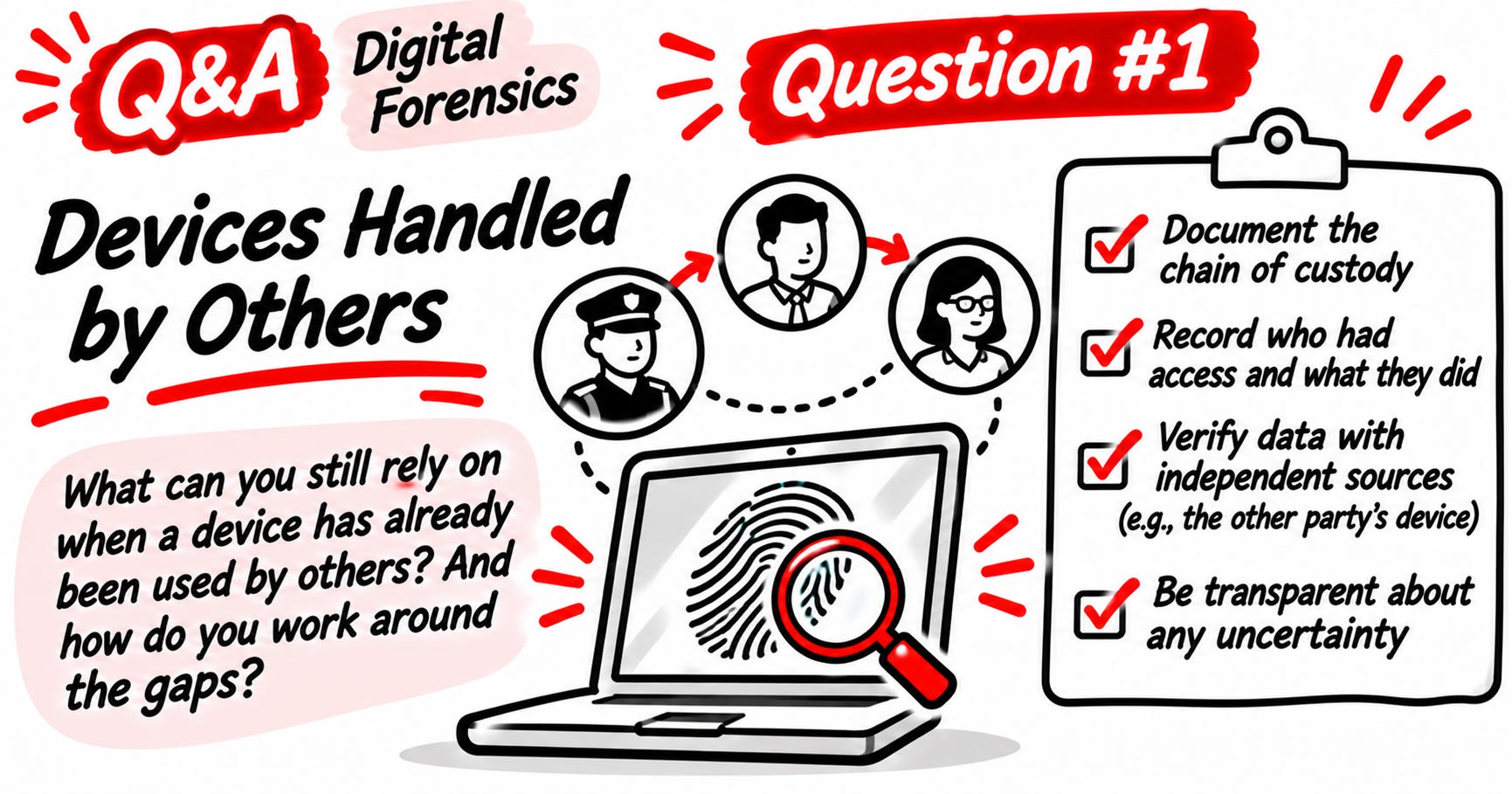
I can still use records whose origin and meaning I can verify, even when a device has passed through other hands. I document who had access, what they say they did, and the device’s condition when I received it. For example, opening a message may change its read status. I would compare it with the other participant’s device and any available records that help establish the timeline. I also explain where earlier handling leaves uncertainty about who performed an action or when it occurred.
My takeaway: Good investigators don’t hide gaps. They document them. The same goes for incident response at a company: if someone “just took a quick look” at a compromised laptop before IR arrived, write it down. An honest gap is better than a confident wrong conclusion.
2. Independent evidence vs. the same story repeated
When several digital records all support the same conclusion, how do you tell whether they’re genuinely independent evidence, or just repeating the same, possibly wrong, story? Have you seen a case where a convincing record turned out to be misleading?
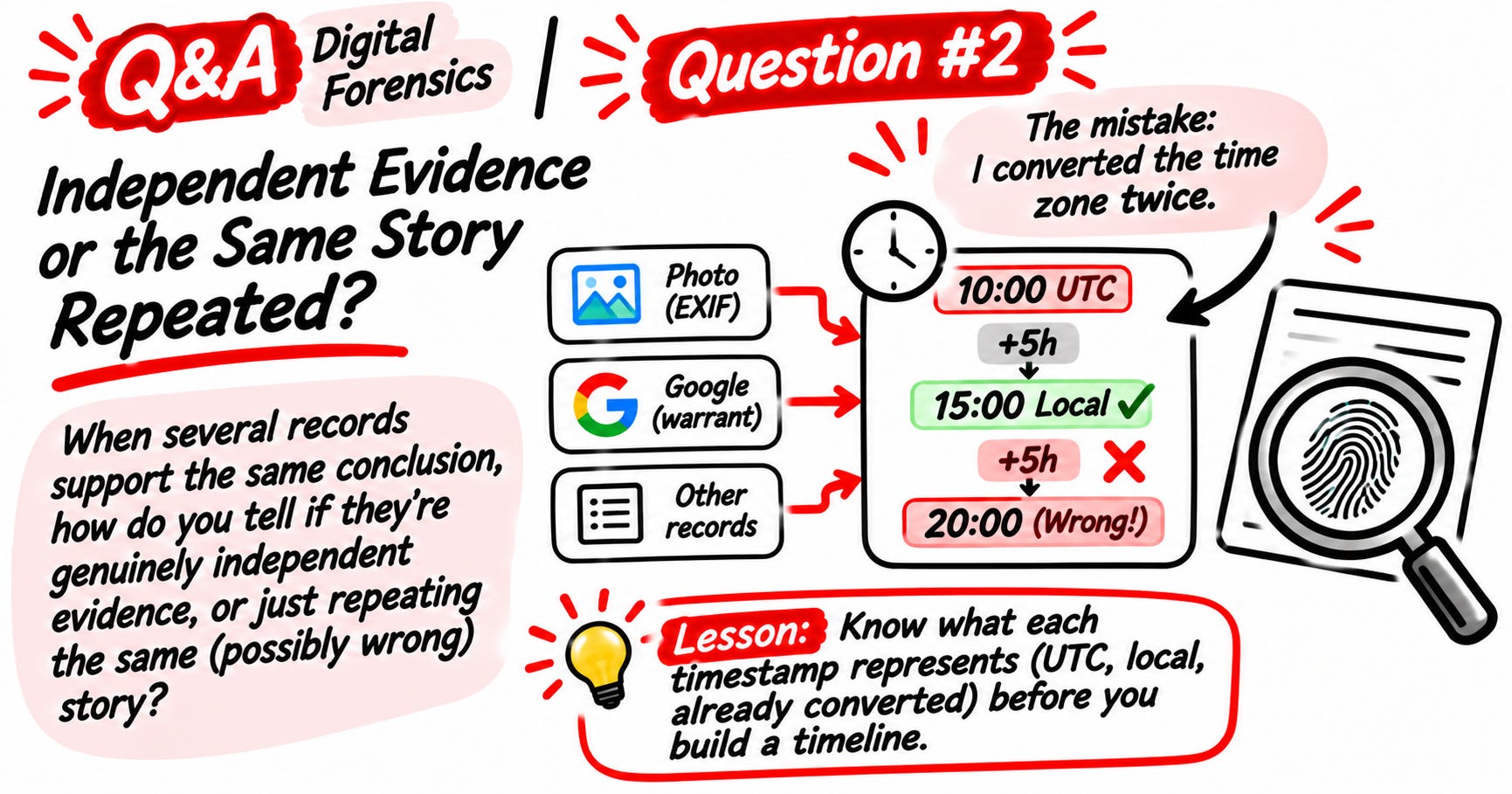
I trace records to their source and check whether they were created independently or copied. In one case, I received a Google warrant return for photos. Google’s timestamp was in epoch format, which I converted from UTC to local time. I inadvertently applied the same adjustment to the photo’s EXIF timestamp from the device, even though it was already in local time. That extra conversion led me to believe the crime had occurred five hours earlier than it did. I later reviewed my work and discovered the error. That experience reinforced why I check what each timestamp represents and how it has been processed before relying on it in a timeline.
My takeaway: this is my favourite answer, because Jeff shares his own mistake. One extra time zone conversion moved a crime by five hours. If you work in a SOC, the lesson is exactly the same: before you build a timeline, know which time zone every log source uses. UTC, local time, and “already converted” look identical on screen.
Have you ever trusted a timestamp that turned out to be wrong? Or have a follow-up question for Jeff about timelines? Tell me in the comments 👇
3. A real investigation
What does a digital forensics investigation actually look like from start to finish? What surprises people most when they see the real process?
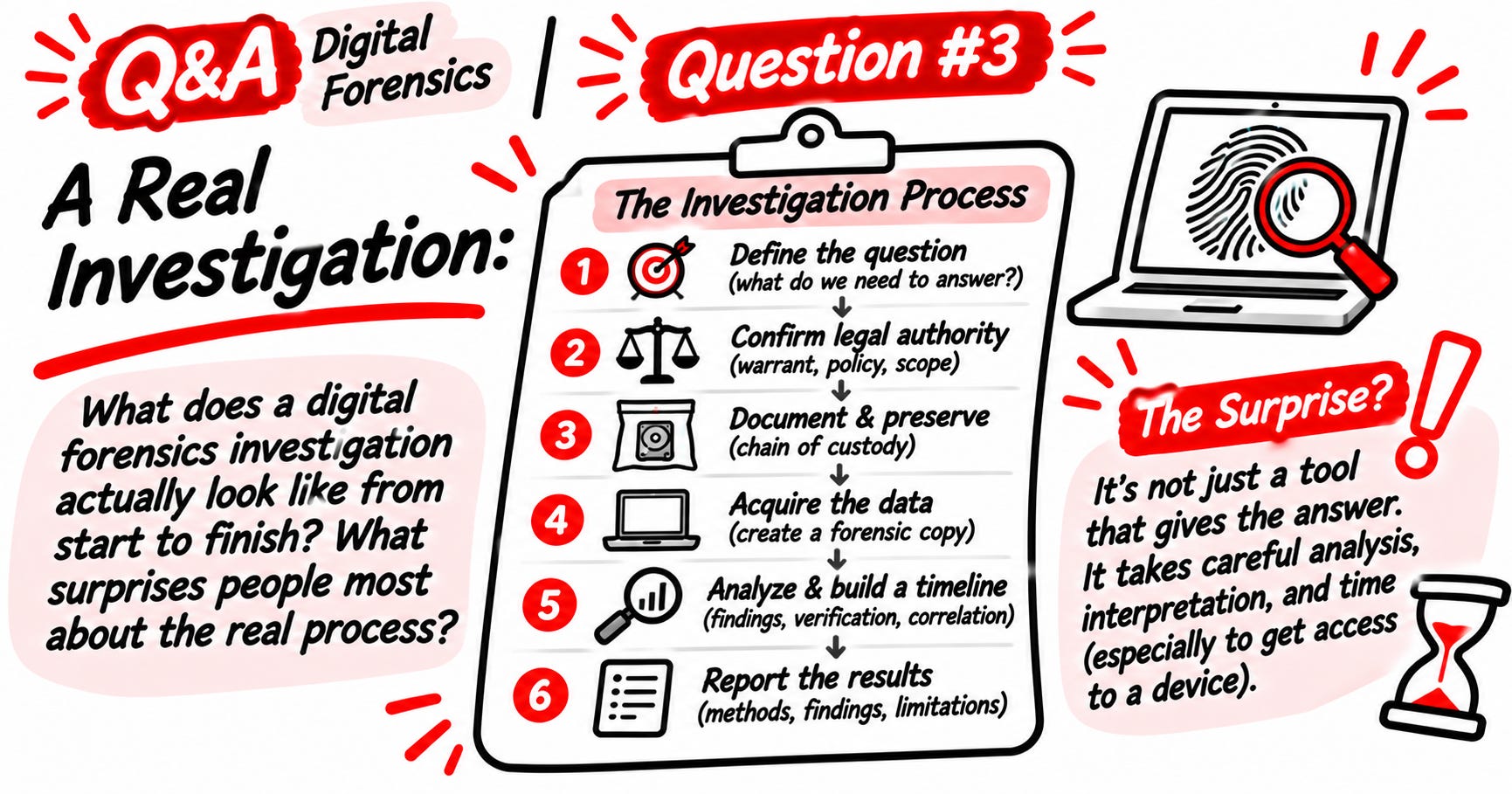
I start with the question the investigation needs answered and confirm my authority to examine the evidence. I document the device and who handles it, preserve it appropriately, and acquire the available data. Then I build a timeline, verify important findings, and compare them with the rest of the investigation. My report explains the methods, findings, and limitations so someone else can follow my reasoning (Ayers et al., 2014). People are often surprised by how much interpretation is involved. A software report takes careful review, and gaining access to a device can itself take considerable time.
My takeaway: notice the first step. Not “plug in the device”, but “what question do we need to answer?” Forensics tools produce reports. People produce conclusions. And a good report includes its own limitations, so someone else can check the reasoning.
4. Mobile forensics
What makes phones harder to investigate than computers today, and what’s the most valuable evidence you usually find on them?
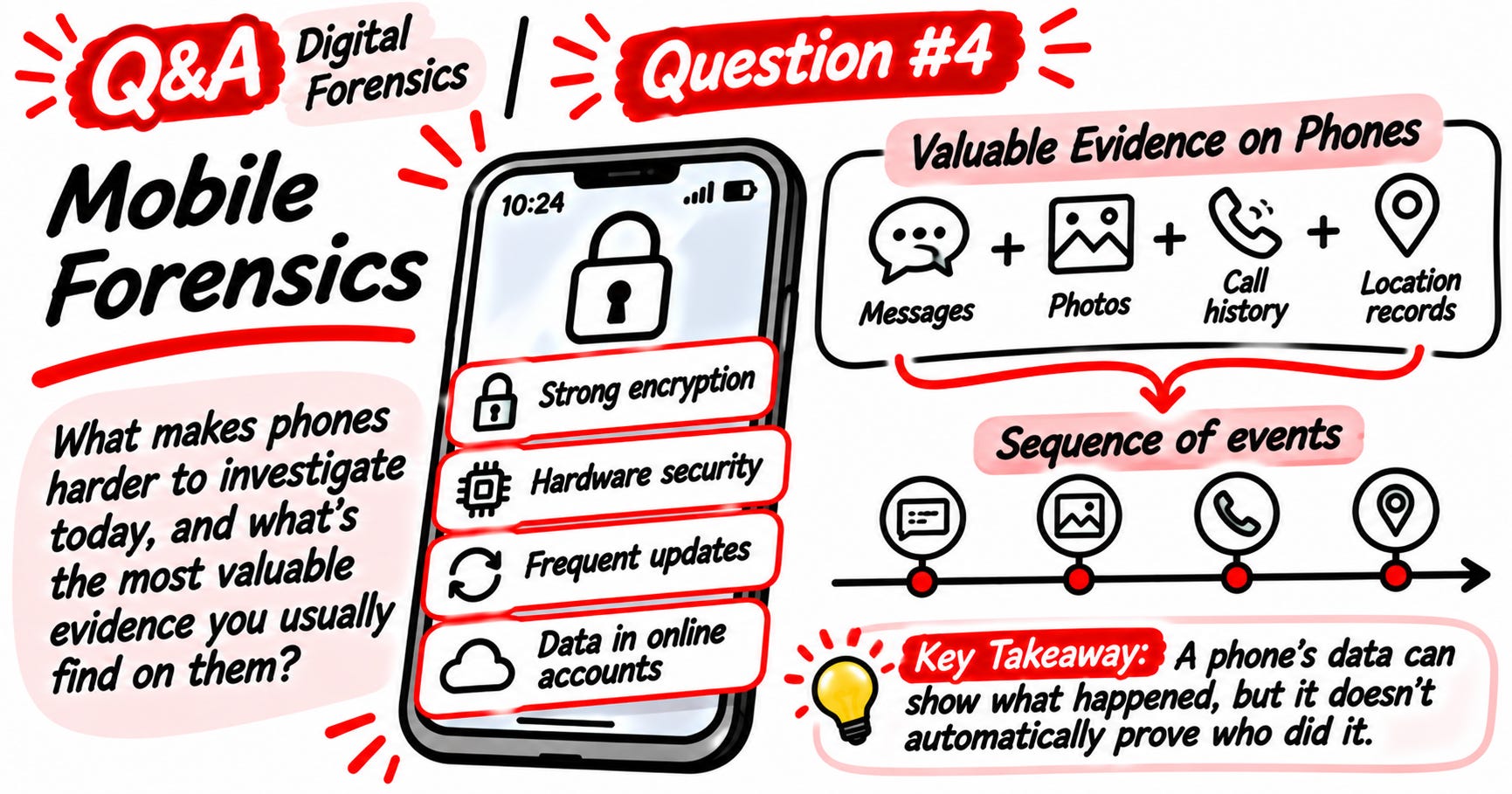
Phones combine strong encryption with hardware security, and access can depend on the model, software version, passcode, and whether the device has been unlocked since its last restart. Frequent updates and data stored in online accounts add to the challenge (Scientific Working Group on Digital Evidence, 2025). Messages are often especially valuable when I can place them alongside photos, call history, and location records. Together, those records can help establish a sequence of events. I still have to evaluate how accurately each record reflects an event and who was using the device at the time.
My takeaway: The same security that protects your phone from a thief also protects it from an investigator. And the last sentence matters most: a message sent from a phone doesn’t prove who sent it. Evidence shows what a device did. Linking it to a person takes more work.
Phones are getting harder to investigate every year. What would you like to know about mobile forensics? Drop your follow-up question in the comments.
5. The legal side
What’s the most common mistake that makes digital evidence unusable in court?
The mistake I would emphasize is searching a device without sufficient legal authority or going beyond the authorized scope. In Riley v. California (2014), the Supreme Court held that police generally need a warrant to search digital information on a phone seized during an arrest, subject to recognized exceptions. Before examining the data, I check what the warrant or other authority permits, including any limits on accounts, dates, or types of records. An unlawful search can lead to suppression. I also document handling and examination so I can explain how the evidence was obtained and verified.
My takeaway: companies make the same mistake in internal investigations. Before anyone searches an employee’s laptop or mailbox, check who authorised it and what the scope is: HR, legal, and whatever your policy and local law allow. The best technical finding is worthless if you weren’t allowed to look.
5 lessons from Jeff’s answers (From my POV)
Document what you can’t verify, not only what you can.
Know what every timestamp represents before you trust it.
Start with the question, not with the tool.
A device’s activity isn’t automatically a person’s activity.
Authority and scope come before any search.
Thank you, Jeff!
A huge thank you to Jeff for taking the time to answer your questions so carefully, and for being honest enough to share his own mistake. That’s how people actually learn.
References
Ayers, R., Brothers, S., & Jansen, W. (2014). Guidelines on mobile device forensics (NIST SP 800-101 Rev. 1). https://doi.org/10.6028/NIST.SP.800-101r1
Riley v. California, 573 U.S. 373 (2014). https://www.law.cornell.edu/supremecourt/text/13-132
Scientific Working Group on Digital Evidence (2025). Best practices for mobile device evidence collection & preservation, handling and acquisition (Version 2.0).
https://swgde.org/
Who should I ask next? A SOC analyst, a penetration tester, a CISO? Tell me in the comments.

Evidence handling, chain of custody and incident response all show up on the ISC2 CC exam. If you read this article and thought “I’d get those questions right,” test it.
The free CC Readiness Test takes 10 minutes and shows you exactly which domains you’re weak in.
Let’s Connect
If you want to collaborate, discuss, or just geek out over networking and cybersecurity, reach out:
Email: erich.winkler@decodedsecurity.com
LinkedIn: Erich Winkler
Gumroad community: Decoded Security
Start Here: Decoded Security Roadmap
Discord: Join here
Enjoyed this article? Like it or drop a comment. I’d love to hear your thoughts and questions!
Let’s learn and grow together!