

A detection rule that is 99% accurate can still be almost useless.
If that sentence feels wrong, this article is for you. Because the people who understand why it is true are the ones who build detections, run SOCs, quantify risk for boards, and get paid more for it.
In this post I will:
Show you why cybersecurity is a data problem wearing a security uniform
Walk through the one piece of math that will show you why good data analysis is essential for threat detection
Give you two working Python scripts (log hunting and risk quantification) you can run today
Map the career paths where these two fields merge, and a 90-day plan to get there
The problem: people treat these as two separate careers
Most beginners see two doors.
Door 1: cybersecurity. Firewalls, certifications, incident response.
Door 2: data science. Python, statistics, machine learning.
They pick one and ignore the other.
Here is the issue. Open any SIEM, any EDR console, any GRC risk register. What are you looking at?
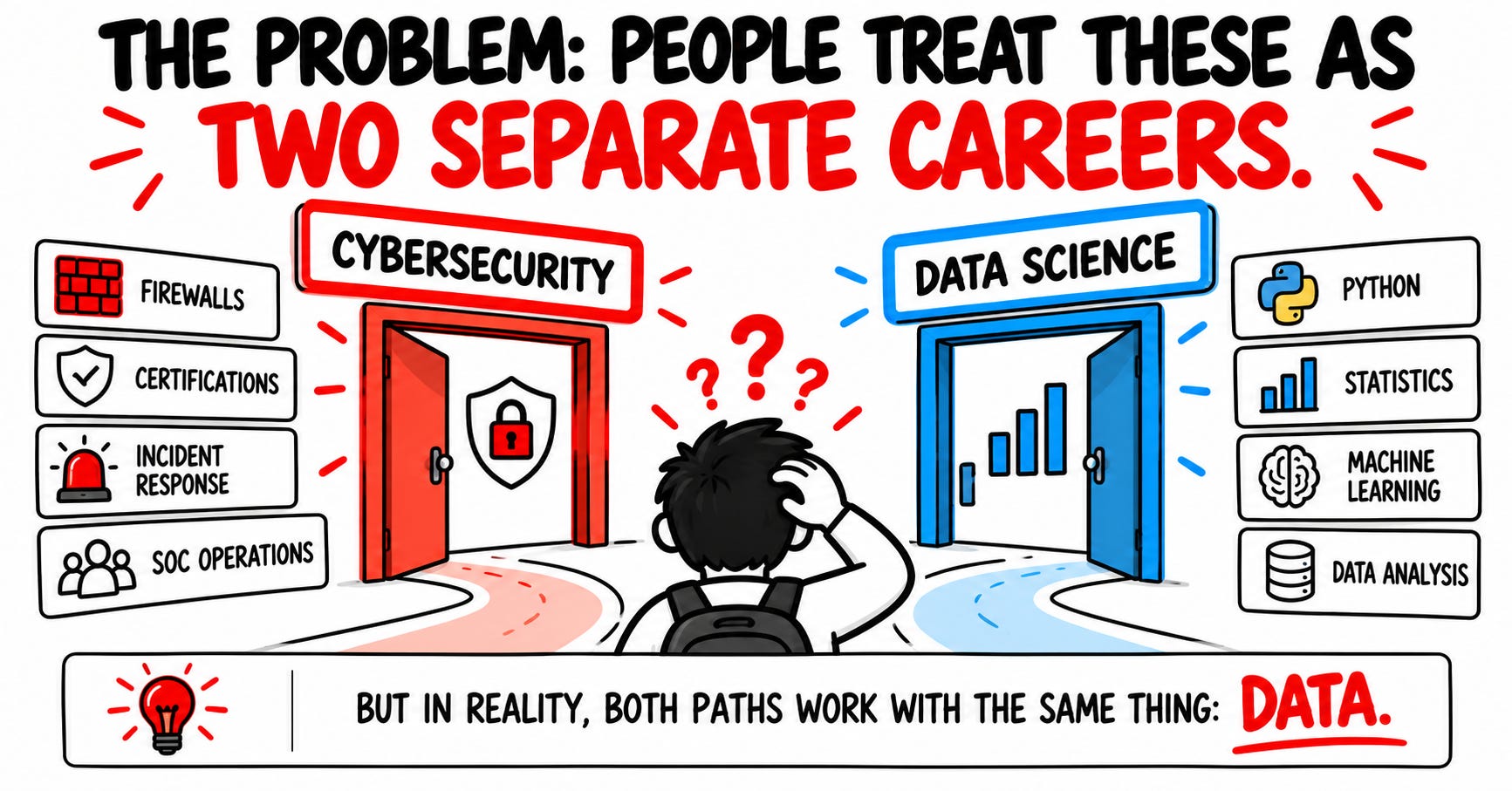
Data. Millions of rows of it.
A SIEM is a data pipeline with alerts on top
A detection rule is a classifier
A risk assessment is a probability estimate
A threat hunt is exploratory data analysis with a hypothesis
You do not need to become a data scientist. But if you cannot think like one, you will drown in alerts you cannot prioritize and risks you cannot explain.
The insight: security is a classification problem
Every security decision boils down to one question: is this thing malicious or not?
That is a classification problem. Data scientists have studied classification for decades. Security people often learn it the hard way, through alert fatigue.
Which brings us back to the 99% accurate rule.
The base rate trap (the most important math in this article)
Imagine your environment produces 1,000,000 events per day. Only 100 of them are actually malicious.
You deploy a detection that:
Catches 99% of malicious events (true positive rate = 99%)
Wrongly flags only 1% of benign events (false positive rate = 1%)
Sounds excellent, right? Now run the numbers:
Malicious events caught: 99 out of 100
Benign events wrongly flagged: 1% of 999,900 = 9,999
Total alerts: 10,098
Alerts that are real: 99 / 10,098 = under 1%
Your “99% accurate” detection produces alerts that are wrong more than 99 times out of 100.
Feel it yourself: open the alert-triage simulator and try to find the real attacks in the noise. Most people are shocked how many alerts are junk.
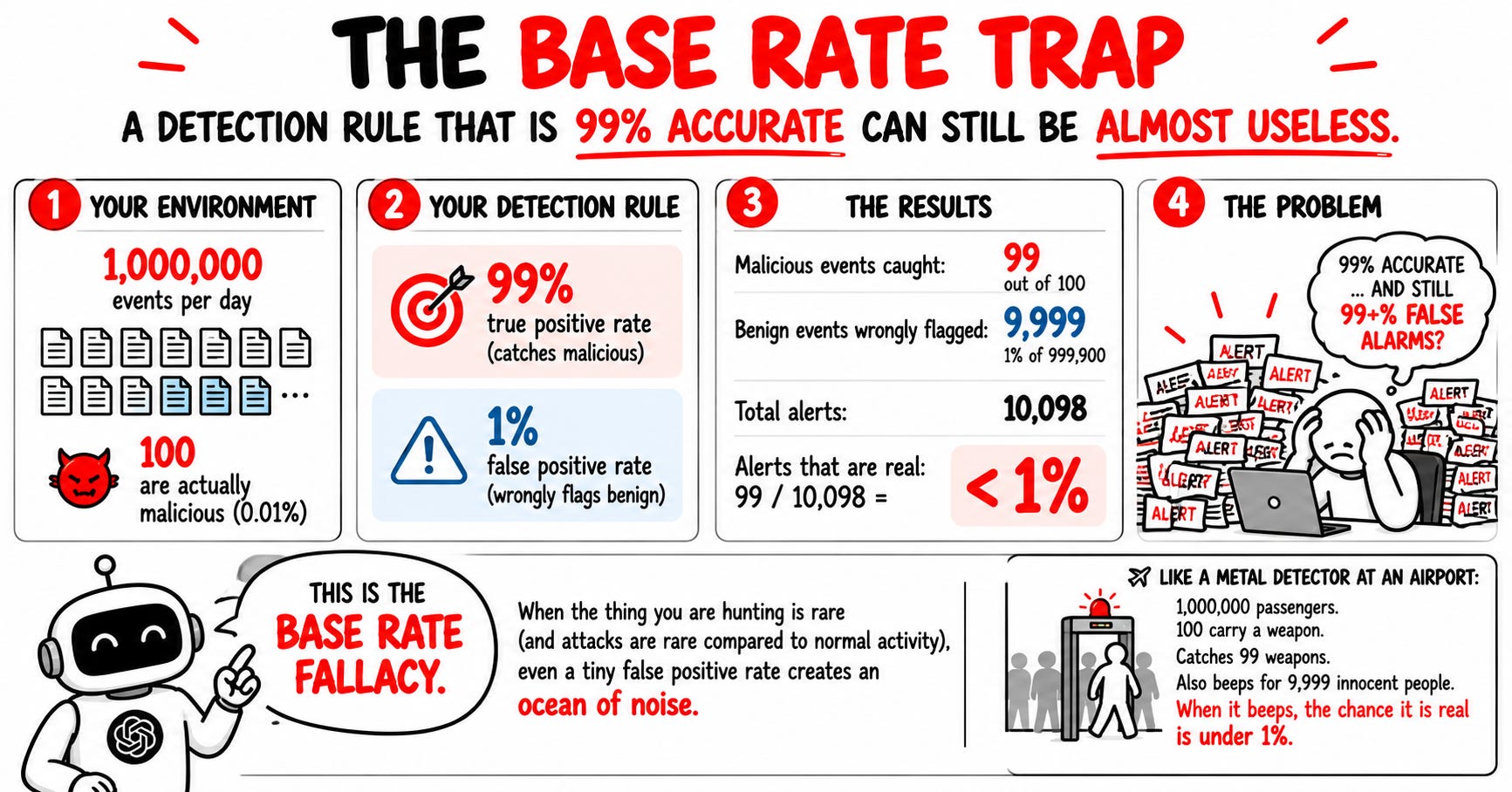
This is the base rate fallacy. When the thing you are hunting is rare (and attacks are rare compared to normal activity), even a tiny false positive rate creates an ocean of noise.
In other words: A metal detector at an airport catches 99% of weapons and beeps wrongly for 1% of normal passengers. 1,000,000 passengers walk through, and 100 carry a weapon. The detector catches 99 weapons. It also beeps for 9,999 innocent people. When it beeps, the chance you are looking at a real threat is under 1%.
What this means in practice:
“Accuracy” is the wrong metric for security. Ask about precision (how many alerts are real) and recall (how many attacks you catch)
Lowering false positives often matters more than catching one more attack
This is why SOC analysts burn out. It is not a people problem. It is a math problem
Interview tip: if someone asks how you would evaluate a new detection rule, say “precision and recall against the base rate.” Very few junior candidates do. It signals you understand the job, not just the tools.
Everything above changes how you read alerts. Everything below teaches you to act on it: two hands-on labs with a sample dataset, the six roles where these skills pay most, and the traps that break real detections.
Start your 14-day free trial to unlock the labs. Cancel anytime.
