

CISSP Domain 7 Security Operations essential topic!
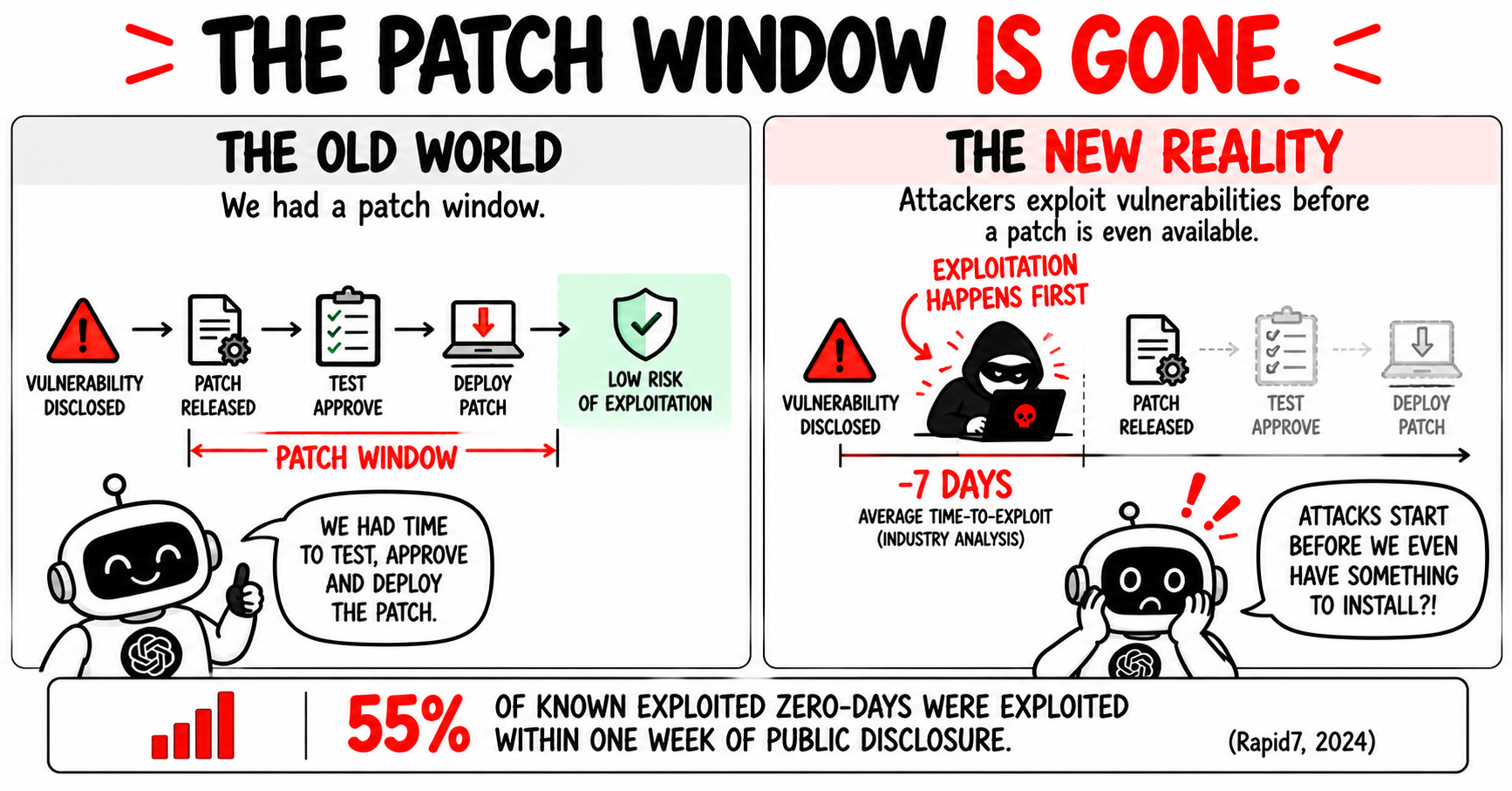
For years, security teams had a patch window.
A vulnerability was disclosed.
A patch was released.
Organizations had time to test, approve, and deploy it.
And when the organization used that window for patching, the probability of exploitation was very low.
Well, here is the bad news: That window is GONE!
A recent industry analysis put the average time-to-exploit at minus seven days.
Yes, that’s right, negative 7 days.
That means attackers were observed exploiting vulnerabilities, on average, before a patch was publicly available.
In other words: On average, the attacks start before defenders even have something to install.
Rapid7 also found that 55% of known exploited zero-days in its dataset were exploited within one week of public disclosure. Rapid7’s research
So, what does that all mean? Are we losing the battle? Should we just all forget what patch management means and give up?
Of course not! As always, we need to take what we already have and adapt it!
Once again, I will explain an essential CISSP topic that, thanks to AI, has become more relevant than ever!
So whether or not you want to take the exam, I suggest you continue reading.
By the end, you will understand:
How vulnerability management and patch management work together
The CISSP patch-management lifecycle: Evaluate → Test → Approve → Deploy → Verify
What to do when a critical vulnerability cannot be patched immediately
Why CISSP knowledge is still essential, even when the patch window has disappeared
First: a vulnerability is not the same as a missing patch
Before we get to the patch management process itself, let me start from the very beginning - establishing the relevant terms.
In this case, the difference between vulnerability and patch management. These two might be very close, but in reality, they are completely different things.
Vulnerability management is how an organization identifies, assesses, prioritizes, and tracks security weaknesses.
Patch management is one way (not ONLY way) to remediate those weaknesses.
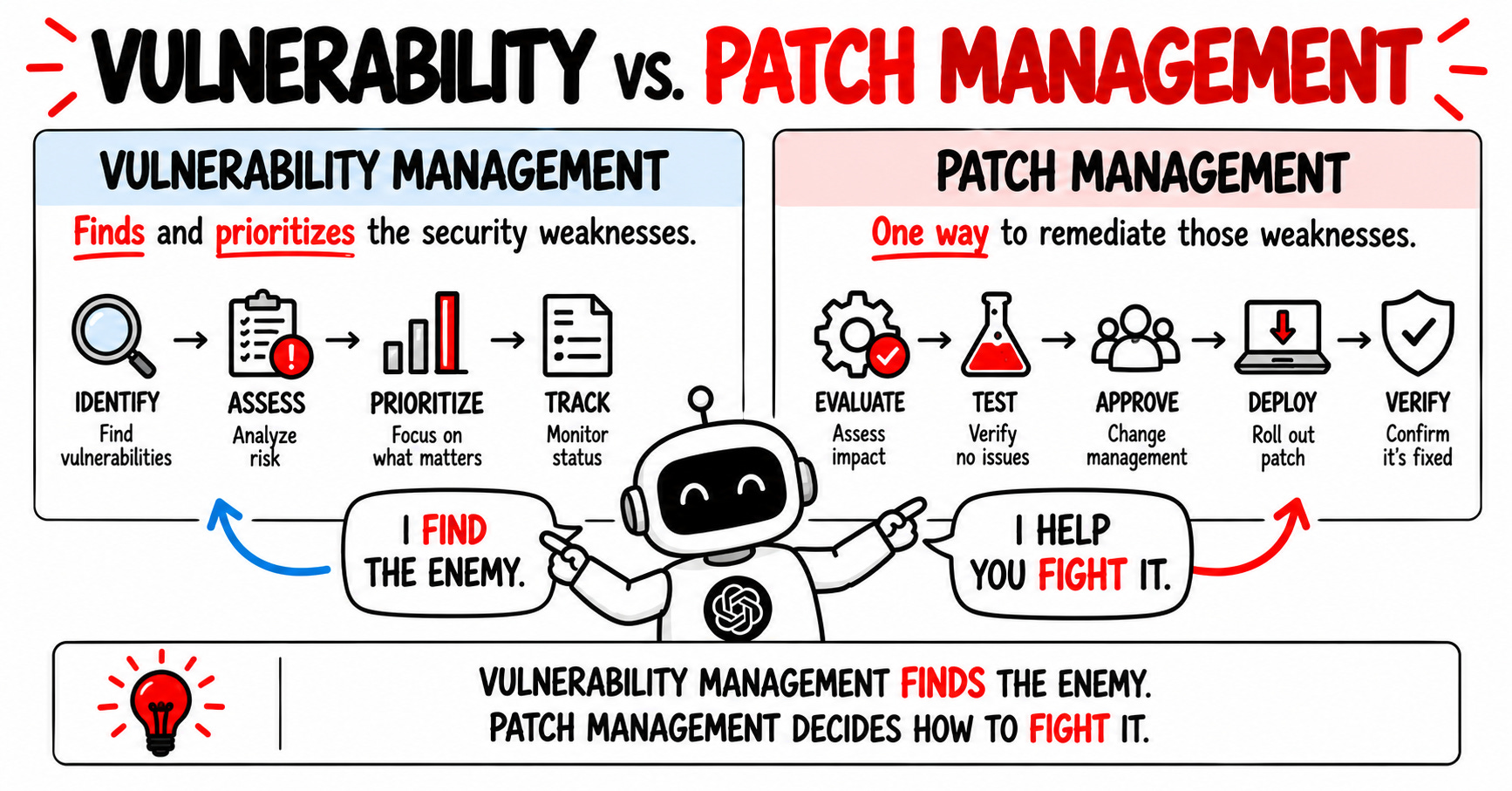
Here is the relationship between them: Vulnerability management finds the enemy. Patch management decides how to fight it.
Patch management process in a nutshell
CISSP note: Vulnerability management identifies weaknesses. Patch management safely remediates them.
As usual, the patch management process is divided into multiple phases where each phase has its own purpose.
The good news is, this is very easy to remember!
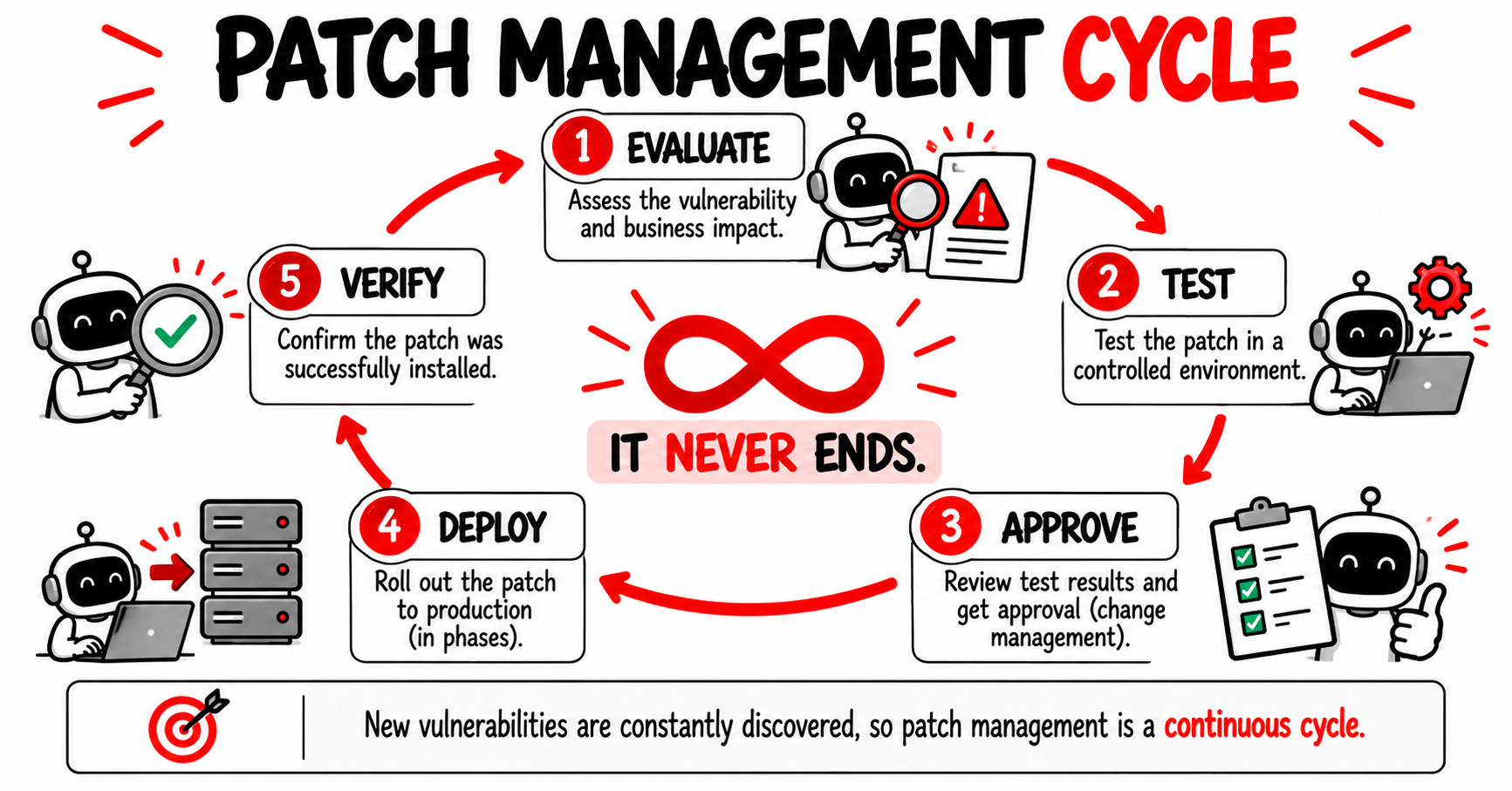
Evaluate
Description: Assess the vulnerability, affected assets, and potential business impact.
Goal: Prioritize based on real risk—not just the CVSS score. A lower-scoring vulnerability on an internet-facing, business-critical server may be more dangerous than a critical finding on an isolated test machine.
What to avoid: Treating every vulnerability as equally urgent, or prioritizing only by severity score.
Test
Description: Apply the patch in a controlled environment or pilot group before broad deployment.
Goal: Confirm that the patch fixes the issue without breaking applications, integrations, or performance. Prepare a rollback plan.
What to avoid: Deploying an untested patch directly to every production system—unless an emergency risk decision explicitly requires it.
Approve
Description: Review the test results, deployment plan, and expected business impact through the change-management process.
Goal: Ensure the right people understand and accept the risk of the change before it reaches production.
What to avoid: Treating patching as an informal technical task with no ownership, documentation, or approval.
Deploy
Description: Roll out the approved patch to production systems, preferably in phases.
Goal: Reduce exposure while limiting disruption. For normal patches, begin with IT and pilot users; for actively exploited vulnerabilities, use an emergency change process.
What to avoid: Waiting for the next routine patch window when attackers are actively exploiting a critical vulnerability.
Verify
Description: Confirm that the patch was successfully installed on every targeted system.
Goal: Prove that the vulnerability has been remediated through patch reports, version checks, and follow-up scans.
What to avoid: Assuming a completed deployment report means every system is secure. Devices may be offline, installations may fail, and reboots may still be pending.
If you cannot verify the patch reached the vulnerable system, you have not won that battle.
Quick self-check: Could you explain the five phases without looking? Explain them in the comments!
One process does not fit every organization
It is important to remember that patch management is a framework, not dogma.
A large enterprise may have dedicated test environments, formal change boards, and multiple approval layers. A small business may not have the people, budget, or infrastructure for that.
That does not mean an SMB should skip patch testing.
It means testing needs to be practical.
Many smaller organizations deploy patches first to IT staff and a small group of power users. They monitor for problems for a few days, then expand the rollout if no issues appear.
The goal is not to copy an enterprise process.
The goal is to reduce security risk without causing unnecessary business disruption.
CISSP takeaway: Security must support business objectives. Apply controls in a way that is appropriate for the organization’s risk, resources, and operational needs.
How does your organization handle critical patches? Does it have a formal test process, a pilot group, or mostly an emergency scramble when a major vulnerability hits?
Leave a comment! I read every single one!
Are we losing the battle or not?
Maybe I should say that we are, to get more views, but I honestly think we don’t lose the battle. Only the old patching model is.
The patch window may be gone, yet patch management is more important than ever.
We need to install patches quicker, monitor vulnerabilities better, and follow a risk-based approach.
Is that enough to keep the organization secure?
Of course not!
Patch management is one essential layer of defense in depth. It works alongside asset management, secure configuration, least privilege, network segmentation, monitoring, and incident response.
Without patch management, you leave known weaknesses open for attackers. Handle it well, and you live to fight another day.
Remember: The goal is not to patch everything instantly. It is to reduce risk faster than attackers can exploit it.
Let’s Connect
If you want to collaborate, discuss, or just geek out over networking and cybersecurity, reach out:
Email: erich.winkler@decodedsecurity.com
LinkedIn: Erich Winkler
Gumroad community: Decoded Security
Start Here: Decoded Security Roadmap
Enjoyed this article? Like it or drop a comment. I’d love to hear your thoughts and questions!
Let’s learn and grow together!
Really nice article as usual — a clear, CISSP‑aligned explanation of patch and vulnerability management, and it gives candidates exactly the structure they need for the exam.
Your point about patch windows effectively becoming “–7 days” should be a call to arms for organisations. It reinforces why real‑world programmes have had to move beyond severity‑based SLAs and adopt a targeted risk‑based approach. When exploitation now precedes patch availability, teams need to prioritise based on exploitability, asset criticality, and business impact rather than CVSS alone.
In practice, that also means building repeatable processes with stakeholder teams and giving them evidence they can believe in and act on. Tools that clearly demonstrate how a vulnerability can be exploited — even one with a low CVSS score — make a huge difference. Automated validation and attack‑path modelling platforms such as Pentera or XM Cyber help teams move beyond a CVSS‑list mindset by showing how seemingly minor issues can become pivot points into more sensitive parts of the environment. That kind of visibility is invaluable for targeting scarce resources and driving remediation and shared ownership.