

Most people talk about AI and privacy as if something was taken from them.
Their data.
Their anonymity.
Their control.
But if I’m honest, and maybe you should be too, nothing was stolen.
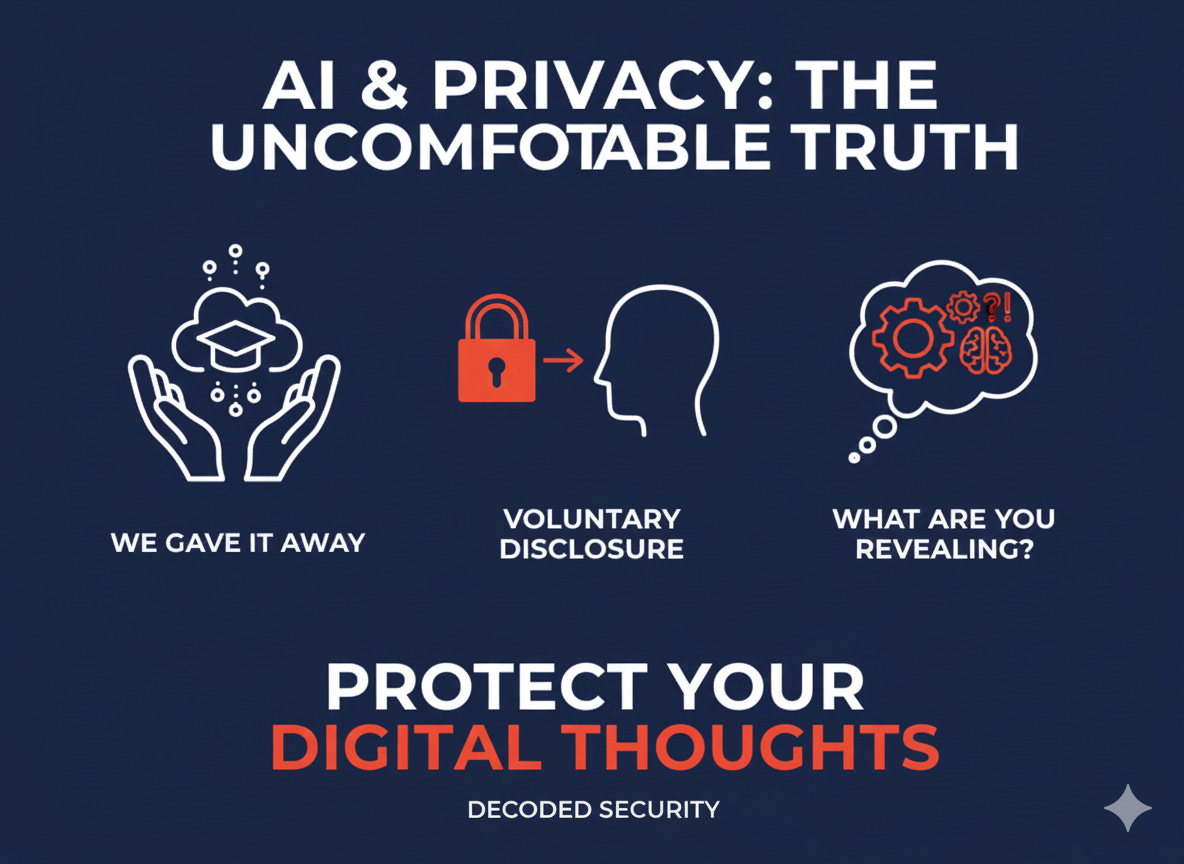
We gave it away.
Not because we were forced to.
Not because of weak laws.
But because it was convenient.
I work in cybersecurity. I’ve seen how systems fail.
And while preparing for the CISSP, I realized something uncomfortable:
AI didn’t break privacy models.
We did.
The first lie we tell ourselves
“I’m not sharing anything sensitive.”
That’s usually true, in isolation.
One prompt here.
One question there.
A pasted email.
A half-anonymized scenario from work.
None of it looks dangerous on its own.
But privacy has never been about single data points.
It’s about context.
And context is exactly what AI is built to accumulate.
Here’s a challenge:
Take a pen and a piece of paper.
Open ChatGPT.
Go through your chat history and write down every piece of personal or professional information you’ve shared.
I think you’ll be shocked within ten minutes.
The real shift most people missed
This isn’t mass surveillance.
This isn’t “Big Brother.”
This is voluntary disclosure at scale.
We are no longer just sharing:
who we are
what we like
We are sharing:
how we reason
how we decide
where we hesitate
And that can be potential even more harmful.
Here’s the uncomfortable part:
What happens when a model starts influencing your decisions because it already knows you well enough?
Most people don’t think about this.
But what if that model is misused, and influences tens of thousands of people at once?
Your thoughts are as much a part of your privacy as your email address.
Protect it!
Find this article interesting? Let me know in the comments! Any feedback is greatly appreciated!
“But I have nothing to hide”
That’s not the point.
Privacy isn’t about hiding wrongdoing.
It’s about controlling exposure.
The question isn’t:
“Is this data sensitive?”
It’s:
“What does this reveal when combined with everything else I’ve already shared?”
Most people never ask that. But you should!
Where CISSP quietly enters the room
One thing that keeps coming up during my CISSP preparation is how often least privilege and need-to-know are treated as technical concepts.
They’re not.
They’re behavioral principles.
AI breaks them effortlessly, not because the system is insecure, but because we over-share by default.
Authentication, access control, encryption… all of that still matters.
But none of it helps if the user willingly provides the crown jewels through a prompt.
Privacy protection is just one small piece of the puzzle of the CISSP exam.
If you want a structured way to master Domain 1 of the CISSP exam, I’ve created something for you.
My CISSP Domain 1 Checklist provides clarity and focus on everything that truly matters for the exam and real-world practice.
➡️ Download it here and stop wasting time on scattered study materials.
Why this matters going forward
AI isn’t going away.
And neither is our reliance on it.
The privacy discussion won’t be solved by:
banning tools
adding more pop-ups
rewriting policies
Adding more laws
The real solution lies in user awareness.
Convenience always wins.
Unless we consciously slow down.
Interested in privacy laws? I have something for you..

What’s the most sensitive thing you’ve ever shared with an AI —
without thinking twice?
Share your thoughts in the comments!
Conclusion: Privacy didn’t disappear. It drifted.
Privacy didn’t vanish overnight.
It didn’t get hacked.
It wasn’t taken by force.
It eroded quietly, one helpful prompt at a time.
AI didn’t create this problem.
It simply exposed a habit we already had: trading reflection for convenience.
You don’t need to stop using AI.
You don’t need to fear it.
And you definitely don’t need to pretend it’s evil.
You just need to be careful what data you insert there!
Pause before you paste.
Think before you explain.
Ask yourself what this reveals, not alone, but in context.
Key Takeaways
Privacy isn’t about hiding secrets: it’s about controlling what you expose and how it can be combined with other information.
AI thrives on context: individual prompts may seem harmless, but together they create a detailed picture of you.
Voluntary disclosure is the new risk: the biggest privacy gap comes from what we willingly share, not from hackers or laws.
Behavioral principles matter: least privilege and need-to-know aren’t just technical rules, they’re habits we need to practice every day.
Pause and reflect before sharing: think about what your data reveals in context, not just in isolation.
Convenience comes at a cost: slowing down and being mindful is the simplest but most effective privacy protection.
And if you’re studying for the CISSP?
This topic will appear in your exam, and understanding these distinctions isn’t something you can avoid.
If you found this helpful, consider joining our community of over 550 people.

Let’s connect
If you want to collaborate, discuss, or just geek out over virtualization and cloud security, reach out to me:
Email: erich.winkler@decodedsecurity.com
LinkedIn: Erich Winkler
Enjoyed this article? Like it or drop a comment. I’d love to hear your thoughts and questions!
Let’s learn and grow together!
Ready to level up your cybersecurity skills?
💬Comment below and tell me what your experience with SLAs is
❓Take the quiz to test your understanding: CybersecErich: Quiz Hub
📰Subscribe (free or paid) to get new posts straight to your inbox.
Share this with a friend studying for CISSP, or anyone curious about cybersecurity.
“Voluntary disclosure is the new risk: the biggest privacy gap comes from what we willingly share, not from hackers or laws.”
this was my big takeaway as well. seems like the new trend. great stuff Erich!